Trust signals and reliability govern customers’ purchase behavior. Trustpilot offers a great platform for businesses and customers to build trust. But when you use it properly in a structured way, it functions as more than a review repository.
This is the largest independent review platform, free for customers and businesses, that can help your business appear on Google Search, AI answer tools like ChatGPT, Gemini, Claude, and others, and Google Ads.

You can use this platform to build trust, influence customer perception of your business, and drive more revenue by leveraging trust. Start with consistent review acquisition to ensure freshness and legitimacy. Follow up with satisfied customers with an integrated automated post-purchase invitation and customized messaging.
Then, use reviews with embedded widgets on high-traffic pages to convince buyers, increase CTR, and boost overall revenue for your business. Trustpilot works better when you treat it as a system, not a badge.
Why reviews decide sales before you do
You need to understand the weight of reviews before understanding Trustpilot. 95% of consumers say that they check only reviews before making any purchase decision, and 54% of consumers trust online reviews more than recommendations from media or influencers. Even 88% of consumers trust reviews from strangers as much as personal recommendations.
The scenario has changed now, and consumers now visit six sites before choosing a business. They check recent reviews, especially reviews from the past two weeks. To sum up, for most businesses with an online presence, Trustpilot can affect a customer’s buying decision.
What Trustpilot is, and why “open” matters
“Trustpilot for Business is a review platform that allows brands to show, collect, and manage customer reviews to gain trust, improve rank, and increase conversions.”
You will get a dedicated page for your business to showcase verified feedback and star ratings from authentic customers. Those reviews are showcased publicly on your website and Trustpilot pages. The system also allows businesses to reply to those reviews, track their reputation, and integrate star ratings for marketing campaigns.
The platform was founded in 2007 in Copenhagen and currently hosts over 330 million reviews. Over 60 million people read reviews per month before choosing a business. Trustpilot is publicly traded (London Stock Exchange: TRST) with over 1.1 million business profiles worldwide.
The most important thing about Trustpilot is that it is open. You cannot control the genuine experience of the users. They will write the reviews without asking you, and those reviews cannot be taken down even if they are negative.
This independence is exactly what customers trust and what matters most. People do not trust reviews published on business websites. They need reviews from a neutral platform that carries weight.
Your TrustScore, based on ratings and other calculations, influences a customer’s trust and decision-making. Conversations mostly happen when the ratings are between 4.2 and 4.9. So this platform matters for every business operating online.
Trustpilot at a glance: the 2026 numbers
It helps to see the entire platform in one place before getting into strategy. You will understand why Trustpilot carries weight for your customers and search engines.
| Metric | 2026 figure |
|---|---|
| Total reviews hosted | 330M+ (Approximate) |
| Review readers | 60M+ people per month |
| Business profiles | 1.1M+ |
| Reviews written | 61M+ per year |
| Countries covered | 100+ |
| Average TrustScore | ~4.2/5 across the platform |
| Fake reviews removed (2024) | 4.5M (90% of them are removed by automation) |
| Public consumer warnings issued | ~7,000 (2023) |
| Positive review share | ~73% |
| Paid Businesses profiles | Under 3% (97%+ use it for free) |
Two things to note here. The average TrustScore is about 4.2. That means the perfect 5-star profile is unusual to users. Second, almost 97% of business profiles on this platform are free profiles and never spend a penny. It tells you to start with the free tier and improve your TrustScore. If you want to know the formula to calculate TrustScore, check our Trustpilot TrustScore Calculation guide.
How it works, day to day
The workflow is simple. For a business, you will claim a free business profile for your website and invite your customers to write reviews through SMS, emails, or other methods. Each review will impact the TrustScore and appear on your profile so that visitors can see it. You will respond to reviews to convert those reviews into a sales pitch for future customers.
The platform screens the reviews automatically for fraud detection and then makes the review live. Trustpilot reports it has removed 4.5 million fake reviews, of which 90% were removed through an automated system.
It also has a human team that checks the reviews after passing the automated system. This rigorous process ensures quality and trust among the users. That’s why it is a wise decision to use legit platforms to manage your Trustpilot reviews.
From a customer’s perspective, the system allows consumers to open an account and share their experience. It helps other users make decisions easily. So overall, the platform works as a medium for users and businesses.
For more explanation, check How Does Trustpilot Work.
Apart from that, Trustpilot shows warning banners on the business profile so that users can understand the quality of the business. If the business breaks or misuses any rules, Trustpilot will show a consumer warning. If the business is under regulatory attention or in a high-risk industry, Trustpilot will show a consumer alert. See our content Trustpilot Warning Banner – Meaning and Fix for details.
Verified vs. unverified reviews: the distinction that changes everything
Trustpilot divides its reviews into two categories: verified and unverified. Verified reviews carry more weight, and buyers trust these reviews more than unverified reviews.
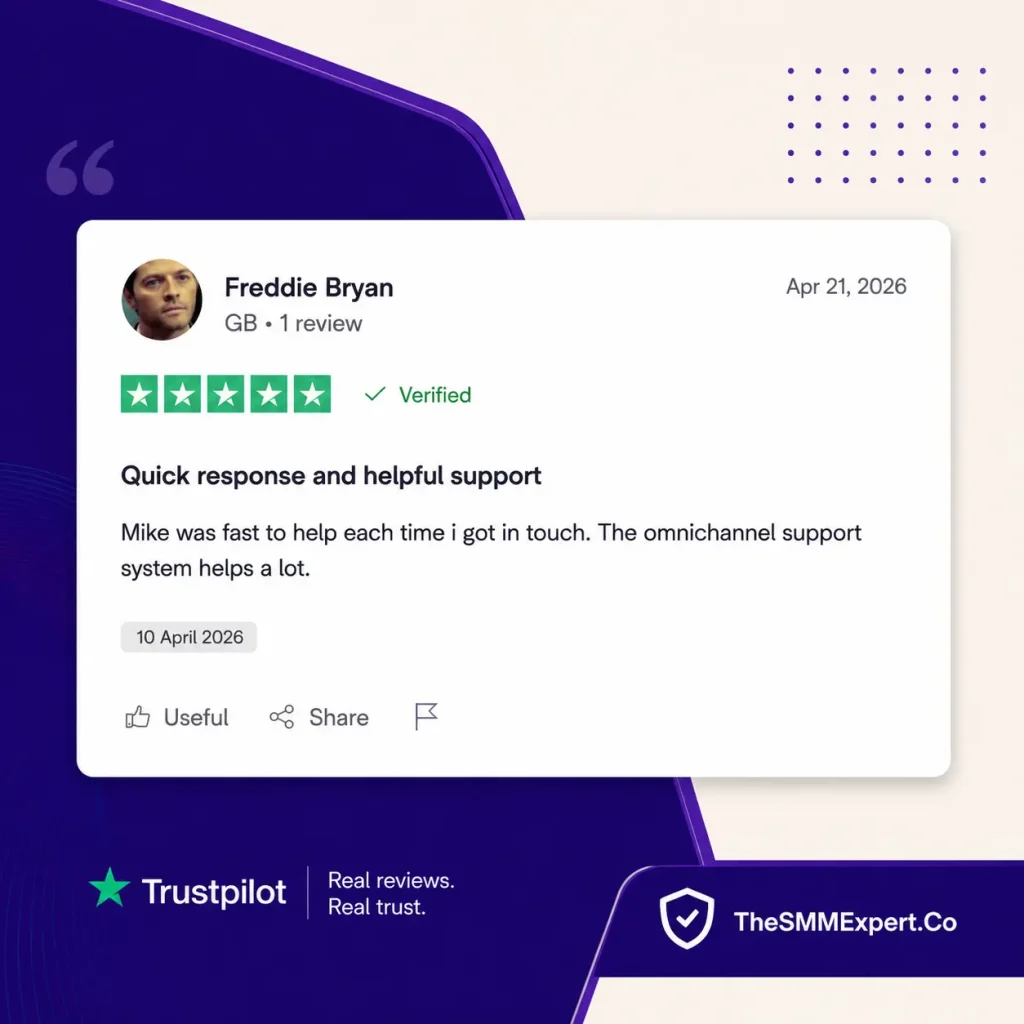
A verified customer review is tied to a confirmed purchase. This label appears when you invite real customers through email, SMS, or other methods to write a review for your business or specific product. A green ‘verified’ label appears beside the review.
An unverified review, on the other hand, is written by someone who found your profile organically. Trustpilot cannot confirm the purchase, labeling the reviews “Invited” or “Redirected”. Most of these reviews might be genuine, but there is always a chance of fake reviews. Also, many competitors sabotage through this.
Keeping more verified reviews will help the business gain trust from customers. A business with 80% verified reviews at a 4.1-star rating reads as more credible than 80% unverified reviews at a 4.8-star rating. Make sure to utilize the Trustpilot review invitation and send it at scale at the right moment to get more verified reviews.
The AI search shift: why Trustpilot suddenly matters more
The biggest change to Trustpilot’s value is AI citation, and most businesses have not realized it yet. Now more people ask about AI tools than search on Google.
When someone asks Gemini, ChatGPT, or Claude about any brand, the AI tool does not think. It retrieves data from trusted sources, and 14% of total citations in AI-generated answers come from review sites, making them the second-largest trust source.
That means if you want your business to get cited in AI search, having a strong Trustpilot profile is mandatory. Check the estimated citation chance for your business.
| Profile status | AI citation rate |
|---|---|
| Zero presence on Trustpilot/review site | ~1% |
| Basic Trustpilot presence | ~53.5% |
| 80+ reviews and consistent responses | ~75.3% |
Understand the table again. If you do not have a presence on Trustpilot or similar top-class review sites, your review profile or brand will stay invisible in AI search. If you don’t know about other options to use, check our Trustpilot Alternative guide.
An active, well-managed profile helps you get cited and improve trust among users. There is also an absence signal for AI citation. Research found that ChatGPT flags a missing profile as a negative, which is a bad signal for your business.
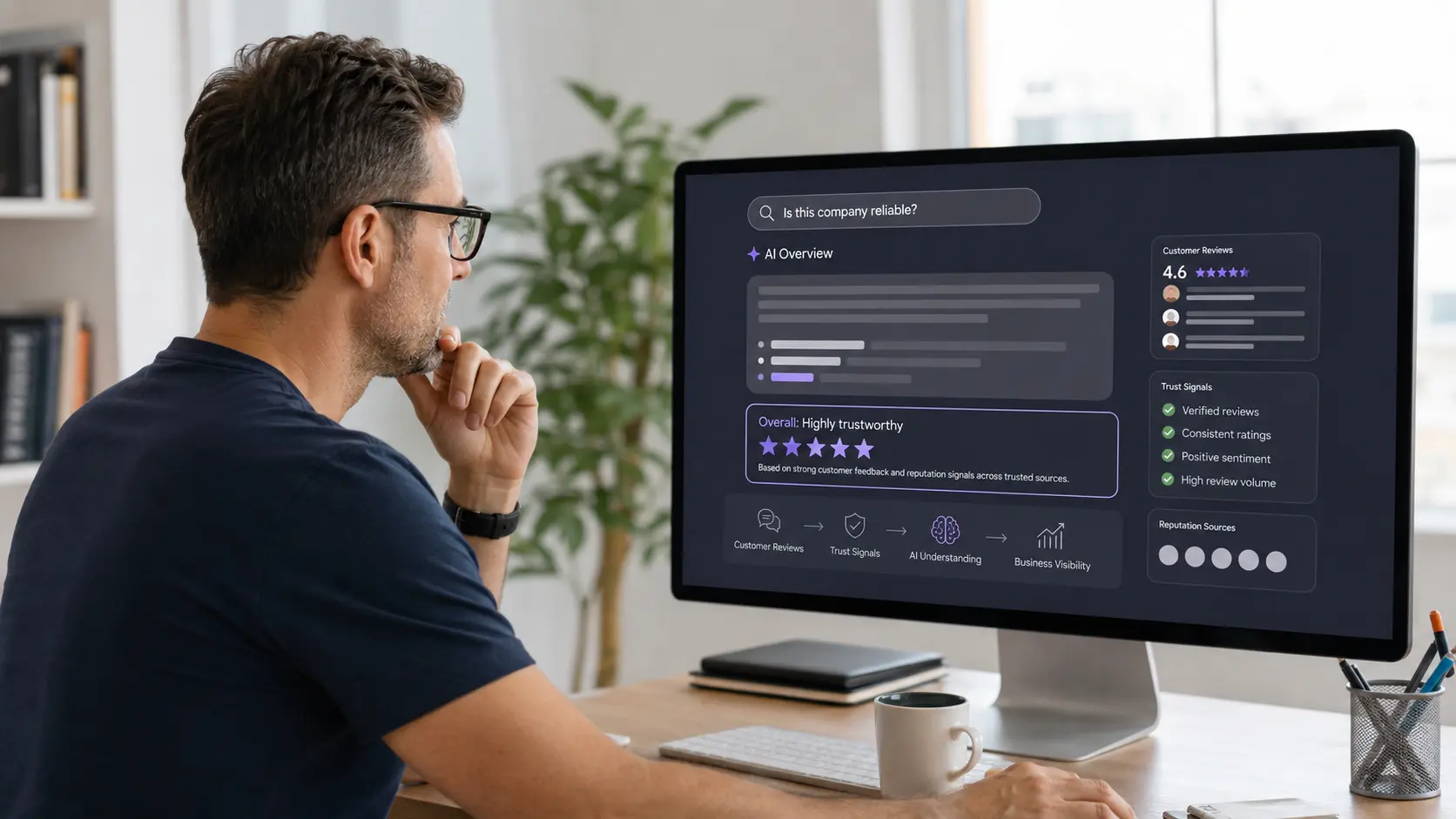
The mechanism behind this citation comes from 3R – recency, relevance, and ranking. Recency means fresh reviews, relevance indicates detailed experience in customer language AI can quote, and ranking means Trustpilot page rank. That’s why collecting consistent reviews beats a one-time burst.
For smaller brands, it creates opportunities. You cannot beat large competitors on Google, but you can build authority through your review profile in AI answers.
What it costs
Trustpilot works on a freemium model. That means businesses can use the platform for free, but they can use premium plans for extra features. Let’s check the details.
| Plan | Starting price (billed annually) | Best for |
|---|---|---|
| Free | $0 | Testing and understanding it; very small businesses. |
| Starter | ~$99/mo per domain | Small businesses under ~$5M revenue. |
| Plus | ~$319/mo per domain | Growing businesses for branding + integrations |
| Premium | ~$799/mo per domain | Large brands needing insights and more widgets. |
| Enterprise | Custom quote | Multi-domain, high-volume business needs. |
Trustpilot often changes the package. So make sure to check the pricing and read its terms and policies before making any commitment. You can check details from Trustpilot Pricing & Plans 2026.
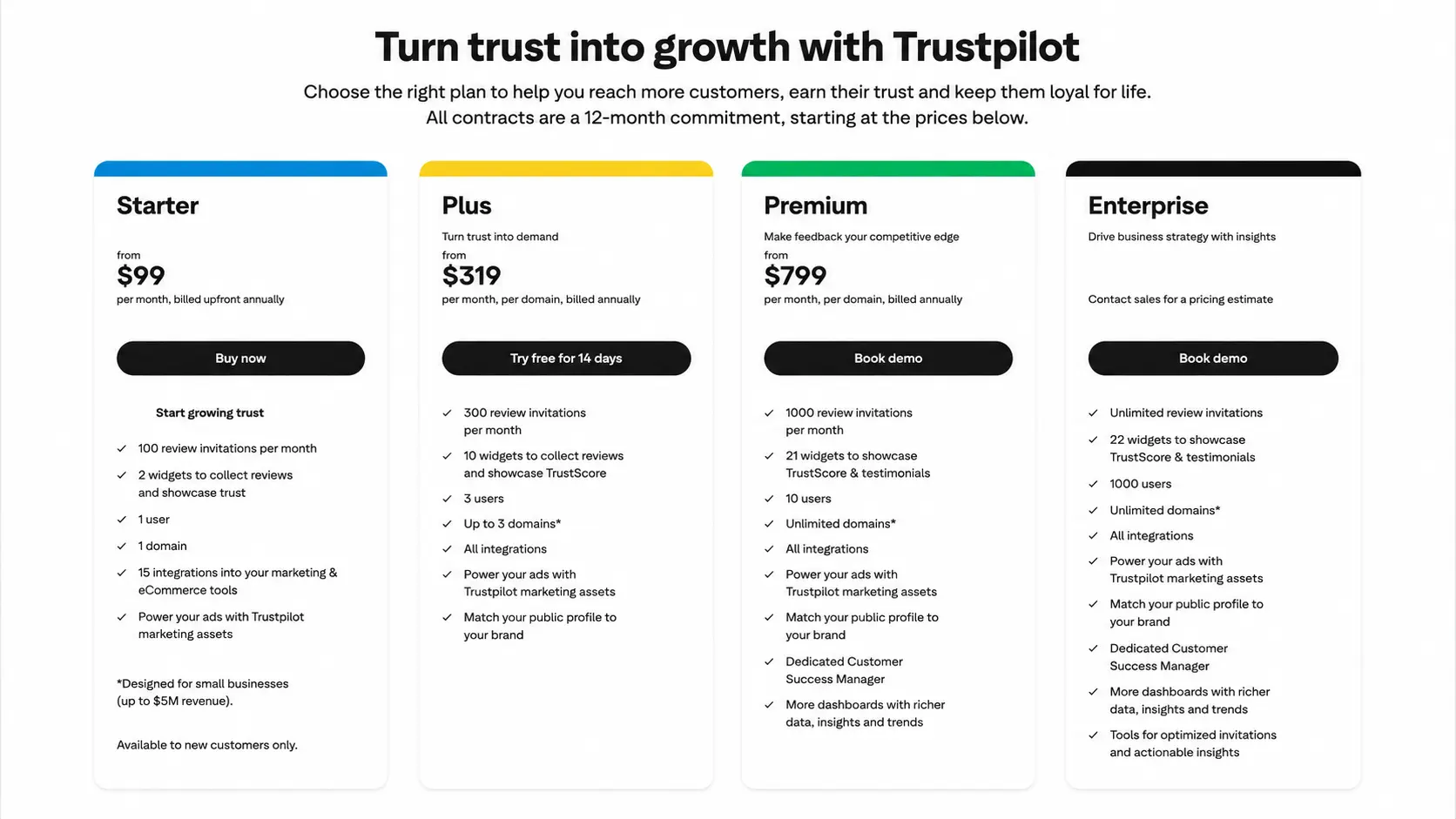
For the pricing, there are two things that most buyers do not like. The first thing is the annual commitment. You need to pay for the entire year upfront. Second is the price per domain. You need to pay per domain. That means if you run three websites, you need to pay for three.
Can you cancel Trustpilot Subscriptions?
Unfortunately, you cannot cancel the Trustpilot subscription before completing 12 months. Since it is an auto-renewal process, you can cancel the auto-renewal. But you must email the authority at least 30 days before the expiry date to prevent this. If you fail to do so, auto-renewal will continue. We have detailed content on how to Cancel Trustpilot.
Why Trustpilot reviews impact sales and conversions
People don’t buy from a brand they don’t know or trust. Trustpilot solves this problem and creates a bridge between a customer and a business. When a customer finds hundreds of verified reviews on the business profile page or product page, they feel less fear during purchase.
Besides, reviews from other buyers influence purchase decisions more than ads or promotional messages. These reviews also work as social proof for new customers. The data backs up the claims.
Displaying reviews on a product page can increase conversions by 270%. Having 100+ reviews can help your business grow significantly. The first 5 reviews have the most impact on your conversion rate.
Real Example: How Buy It Direct Improved Conversions
Buy It Direct is a UK-based e-commerce platform offering tech products and home appliances. They faced a common problem that most e-commerce sites face – visitors went to landing pages but left without buying anything.
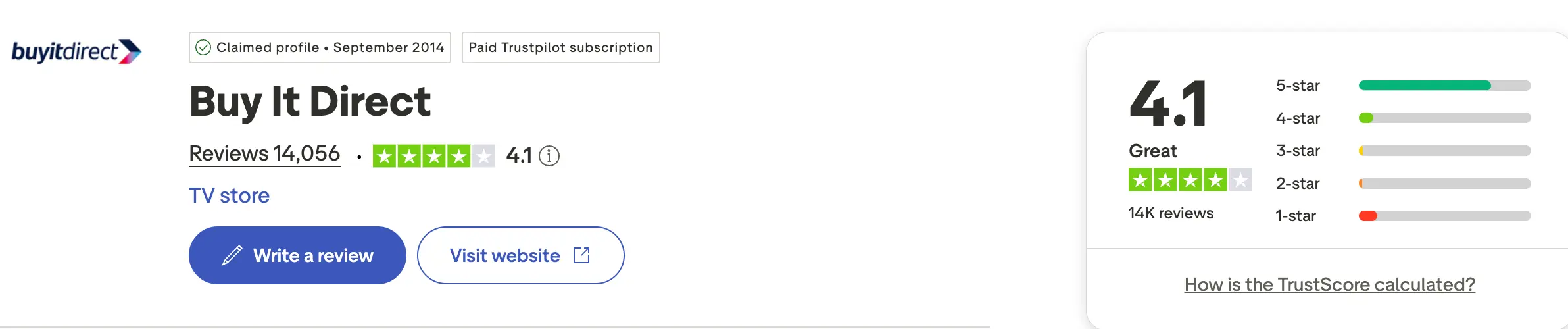
Then they integrated Trustpilot reviews and ratings from verified buyers into their product pages and checkout pages. The company encourages buyers to leave reviews after a satisfactory purchase. New customers visited the site and checked reviews from genuine buyers. It increased by 15% with the same traffic they had before by just making new visitors confident about buying.
You must consult a professional or expert like TheSmmExpert to improve your conversion through review and reputation management.
How to turn Trustpilot into real conversions
Collecting reviews is only half the job done. You need to turn those reviews into a sales system, and to do that, follow the steps below.
1. Collect consistent reviews
Consistency and freshness are important to increase conversion. Don’t wait for your customers to leave reviews voluntarily. Send them a follow-up message through sms or email after a purchase as a reminder. Keep it short, simple, and timely – within the first 24 hours of delivery.
2. Display reviews on the pages that matter
Keeping reviews on the Trustpilot page will not improve conversion. You need to put reviews where a buyer makes a decision – especially in pricing, checkout, or the product page. A star rating widget on the product page can help influence a customer’s decision-making. So don’t hide reviews on pages no one visits.

3. Respond to feedback
Respond to every positive and negative review to show that you are active and care about customer feedback. When potential customers see that you acknowledge the problem and fix it right away, they feel confident buying your product. The message will be the opposite if you ignore negative messages. Check our content to learn how to respond to Negative Trustpilot Reviews,
4. Build review volume gradually
Businesses with hundreds of reviews are more trustworthy than businesses with a few reviews, even if they both have the same rating. Volume signals trust, customer experience, and longevity for the business. In competitive markets, many businesses also focus on ways to improve Trustpilot ratings to maintain visibility and credibility.
5. Maintain trust signals across channels
Showcase your trust signals across different platforms and channels such as Google Shopping ads, landing pages, email signatures, and anywhere you feel it is needed. The more consistently your rating appears, the better trust signals your customers will get.
However, some businesses will still have lower reviews. You can learn more from here. Why Most Banks and Travel Agencies Have Poor Ratings on Trustpilot.
Setting up Trustpilot: your first 30 days
Maintaining a strategy or calendar when you are starting from zero is a good thing. And doing them in order is also important. Follow this 30-day sequence to keep your growth natural and consistent.
| Timeframe | Focus | What to do |
|---|---|---|
| Days 1-3 | Claim & set up your profile. | Claim your free profile, write your bio, add a logo and business details. Read the guidelines. |
| Days 4-10 | Send first invitations. | Start sending invitations to your customers. Find the milestone points to send invitations. |
| Days 11-20 | Automate the invitation. | Automate invitations officially from Trustpilot so invitations go out after every milestone. |
| Days 21-30 | Display & respond | Use a widget to show ratings and reviews on your homepage and product pages. Respond to every review. |
Remember that steady growth always beats a one-day flood. A sudden spike of identical 5-star reviews looks fake and suspicious to customers and platforms. If your business is brand new and wants to increase your Trustpilot reviews, you must follow the table above.
Connecting Trustpilot to your existing tools
Trustpilot becomes powerful when you collect reviews automatically, tied to a real purchase. Manual invitations work at first when you have a small number of customers. But you cannot scale it, and inconsistency kills the flow.
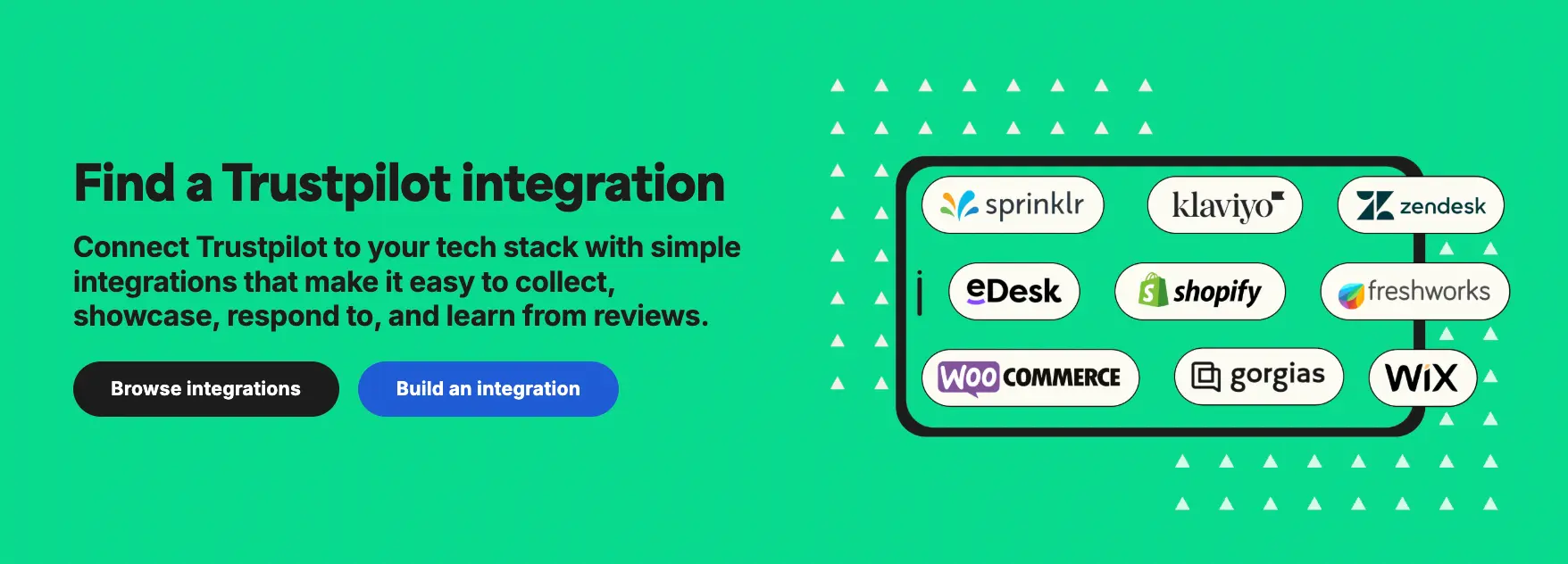
Trustpilot offers native connections to major platforms such as Shopify and WooCommerce so you can send invites for free after every order automatically. You can even integrate Trustpilot Reviews with Klaviyo and Dotdigital for email marketing. If you think replying to reviews is a hassle, you can even automate those replies via Slack and ChatGPT. It will speed up the collection and responses.
Pulling data from your own product page and dashboard for analysis is also possible with the Trustpilot API. For a large business with so much data, this automation helps a lot to analyze and decision-making.
You can even showcase your reviews and star ratings on your product page, cart page, home page, and checkout page to improve conversion. Adding Trustpilot widgets to your website opens that door.
Common Mistakes Businesses Make
- Ignoring reviews after collecting them: Read and respond to the reviews to understand the pain points of your customers. Solve their problems and get more sales.
- Inconsistency in collection: Inconsistency is a red flag for search engines, review platforms, and users. Getting 100 reviews in a single day and not getting anything for the rest of the days will look unusual, bringing negative results for your business.
- Patterns that look fake: A sudden spike in 5-star ratings with the same writing tone creates suspicion among users and the platform. Genuine reviews will be different from each other in length, content, and tone.
- Only showcasing the good: Hiding negative comments will lose your credibility. A business with 500 reviews and an average 4.3-star rating is more credible than a business with 50 perfect 5.0-star reviews.
Apart from those four mistakes, there are some other handful of mistakes that lead to real penalties.
| Mistake | What it costs you | How to fix it |
|---|---|---|
| Incentivizing or buying reviews. | Rules violation; leads to a public warning banner and lost trust. | Collect genuine reviews through invitations. |
| Cherry-picking only your satisfied customers. | A perfect 5-star profile reads as fake. | Invite all customers and get positive and negative reviews to maintain a 4.2-4.9 range |
| Reporting all the negative reviews. | Penalize misuse of the flag system. | Only flag genuine breaches of policy. |
| Going quiet after setup. | Recency decay lowers your TrustScore, SEO, and AI visibility. | Be consistent in review collections. |
| Ignoring any negative reviews. | Signals you don’t care about your customers; scares off future buyers. | Reply to all the positive and negative reviews calmly and publicly. |
| Considering Trustpilot as a badge, not a system. | Less conversion and ranking payoff. | Utilize the platform by collecting, displaying, and responding continuously as one workflow |
The honest downsides: what businesses actually complain about
Trustpilot offers many benefits to business owners. However, there are some downsides people actually complain about. These claims come up again and again in different forums. Knowing them up front will help you decide whether to use this one.
-
- Fake reviews: The most common complaint is that anyone can post a review, and removing a fake review is time-consuming and frustrating. Since the platform is open, a competitor can easily sabotage the platform and leave hundreds of negative reviews. Those reviews can be removed only when they violate a specific guideline. Simple fake or negative reviews are hard to remove.
- Scripted customer support: Many businesses claim that they get templated responses from customer support rather than real solutions.
- Mafia Controversy: In December 2024, short-seller Grizzly Research accused Trustpilot of favoring paid plan users. And people agreed with that claim. They claimed that removing reviews is easier on the paid plan than the free plan. However, Trustpilot denied the claim and noted that over 97% of businesses on the platform are free users. It also assured that it is not taking a side.
- Rating drops without your fault: Aged reviews, a sudden spike of negative reviews, or a change in the score calculation can drop your rating. If you experience this, you can check Why Did My Trustpilot Rating Drop.
Which business types actually benefit most?
Remember that Trustpilot is not a good option for all types of businesses. Understanding your business and choosing the right platform is important to get the payoff. Check the table to decide.
| Business type | Why it fits (or doesn’t) |
|---|---|
| Ecommerce/DTC | This is the perfect fit. Buyers check reviews before checkout, and product-page widgets convert directly. |
| SaaS/B2B | Growing fit. B2B buyers check Trustpilot for additional info along with other specific platforms. |
| Finance & insurance | Reduces buyer fear for high-value, high-trust purchases. |
| Travel & bookings | Not the best fit but can influence the decision. |
| Local & service | Useful for cross-checking. Google Business Profile dominates here. |
You should check Trustpilot’s Ecommerce vs SaaS vs Local Businesses: Which Actually Pays Off in 2026 for a detailed cost-and-return breakdown for your business before choosing the platform.
Is it actually worth it?
Trustpilot is a legitimate platform for customers and businesses. However, the question is whether you should list your company or pay the premium for your business to get those extra features or not. Check our content for details Is Trustpilot Legit & Trustworthy in 2026.
The answer depends on your business type and current condition. For a business that no one knows, listing it will be a good decision since you will get exposure and people will see your business. At the same time, it will give you some SEO boost and increase conversions. You can even use the star rating on your product page to gain the trust of new customers.
It also helps you improve CTR in organic search results and Google Ads. This also works for B2B businesses, as most B2B buyers check reviews and compare.
However, remember that no platform is perfect, and Trustpilot is no different. Even after an automatic and manual review process, fake reviews are being injected. However, you can easily detect those fake reviews. Check out our content: How to Spot and Remove Fake Trustpilot Reviews.
How to measure whether Trustpilot is paying off
Understanding the return is important to run a successful business. Before choosing Trustpilot, you need to understand how to measure whether it will pay off or not.
| What to track | Why it matters | Where to look |
|---|---|---|
| Conversion rate of your business with vs without a widget. | Direct proof of impact of reviews on conversion. | Your performance analytics, A/B split. |
| Verified reviews over time. | Steady growth signals trust and credibility to buyers, AI, and search ranking. | Dashboard in Trustpilot profile. |
| TrustScore trend | Direction matters (not just the number). | Dashboard in Trustpilot profile. |
| Response rate to review invitations | Improve trust and AI citation likelihood. | Trustpilot dashboard. |
| Star ratings in Google search results. | Influencing SEO. | Search for your own listings on Google. |
| Brand mentions in AI citation. | The newest, best, and fastest-growing payoff. | Ask ChatGPT/Gemini/Claude for your brand. |
However, make sure to give it proper time – 6 months minimum – before judging the performance. Reviews compound, and the value of a profile with 200 reviews is not double to a profile with 100 reviews. It is much more than that because recency, responsiveness, and volume influence the trust engine.
Does Trustpilot have SEO and marketing payoff?
Yes, since this is a certified Google partner, the star ratings you have gathered are shown in rich snippets in seller ratings and organic results for Shopping and Google Ads. You will get better rankings in the search results and a better click-through rate, improving organic traffic and conversions.
Newer tools like Gemini, ChatGPT, Claude, and others cite businesses or suggest businesses with higher trust ratings. So the impact is huge for ranking. Besides, you can use those ratings and reviews to promote your product page, social media, and other platforms. It will improve trust among potential customers and increase sales.
How Trustpilot compares to the alternatives
Trustpilot has many competitors, and you can choose any platform depending on your target customers, business size, and other factors. Let’s check the decisive factors and compare those platforms.
| Platform | Strongest for | How it differs from Trustpilot |
|---|---|---|
| Google Business Profile | Local and map visibility. | Less control over branding but free and tied to Google. |
| Feefo | Verified-buyer-only reviews. | Invitation-only, which reduces fake reviews. |
| Reviews.io | Growing e-commerce on a budget. | Easier and cheaper entry, better Google syndication. |
| Judge.me | Shopify product reviews. | Low-cost, product-focused. |
| Yotpo | DTC brands need reviews + loyalty + SMS. | Not a neutral platform. |
| Facebook Recommendations | F-commerce, local brands. | Focus mainly on social trust. |
That means, if you are operating locally, Google Business Profile is the best option. If you focus on F-commerce or social media marketing, a Facebook recommendation is better. The other options are good as side options that you can use along with Trustpilot. You can check our article to learn details about Trustpilot vs. Google Business Profile or Trustpilot vs Judge.me vs Reviews.io.
Frequently asked questions
Is Trustpilot free for businesses?
Yes. Trustpilot is a free platform for businesses to claim a profile, collect reviews, and reply to reviews. However, it has a paid plan that offers branding, analytics, higher invitation volumes, a widget, and other features.
How much does Trustpilot cost?
The paid plans start with $99/month for Starter, then $319 for Plus and $799 for Premium per domain, billed annually. You can also customize the plan if you manage a large enterprise.
Can a business remove a bad Trustpilot review?
No, you cannot remove a Trustpilot review just because it is negative or unfair. The review must violate the rules, including being fake, abusive, or not based on a genuine experience, to be removed.
Is Trustpilot worth it for a small business?
Yes, Trustpilot is worth it for a small business if you have an online presence. Businesses in e-commerce, finance, insurance, and travel can gain significantly.
Does Trustpilot help with SEO?
Yes, Trustpilot is a certified Google partner that can surface your star ratings in organic Search and Ads. It improves AI citation, local search ranking, and CTR.
What’s the ideal Trustpilot rating to aim for?
Do not aim for a perfect 5-star rating since people often suspect those perfect businesses. Go for roughly 4.2 to 4.9 stars to be trustworthy to your customers.
Does Trustpilot affect whether AI tools recommend my business?
Yes, Trustpilot has a real impact on AI recommendation and citation for your business. Research shows that businesses with no activity or profiles on review sites have less than a 1% chance of getting a citation.
What’s the difference between a verified and unverified review?
Verified reviews are reviews that Trustpilot can confirm with a verified transaction. Unverified reviews come from someone who found your business profile with no confirmed purchase.
What’s the ideal Trustpilot rating to aim for?
You should aim for a 4.2-4.7-star rating on Trustpilot for your business, since a perfect 5-star rating can seem suspicious to customers and the platform.