Trustpilot is an independent online review platform launched in 2007. It is an independent third-party review platform where customers can share genuine experiences with different businesses, and the businesses themselves are also given a chance to engage with the customers, increasing their online reputation and giving customer trust signals.
Till the end of 2004, Trustpilot is reported to have 301 million active reviews and 61 million reviews written in 2024. The platform also reported 57 million monthly active users and 117 billion annual brand impressions in 2024.
The platform, with its review transparency, allows businesses to showcase their social proof and e-commerce credibility to potential customers through the vast number of reviews available on the platform, while at the same time increasing their customer conversion.
The number and ready availability of reviews matter very much in this matter; even 5 reviews can increase conversion rate by 270%. Furthermore, 98% of customers claim that reviews are essential to their purchase decisions, while 45% directly state they will not choose a business without reviews.
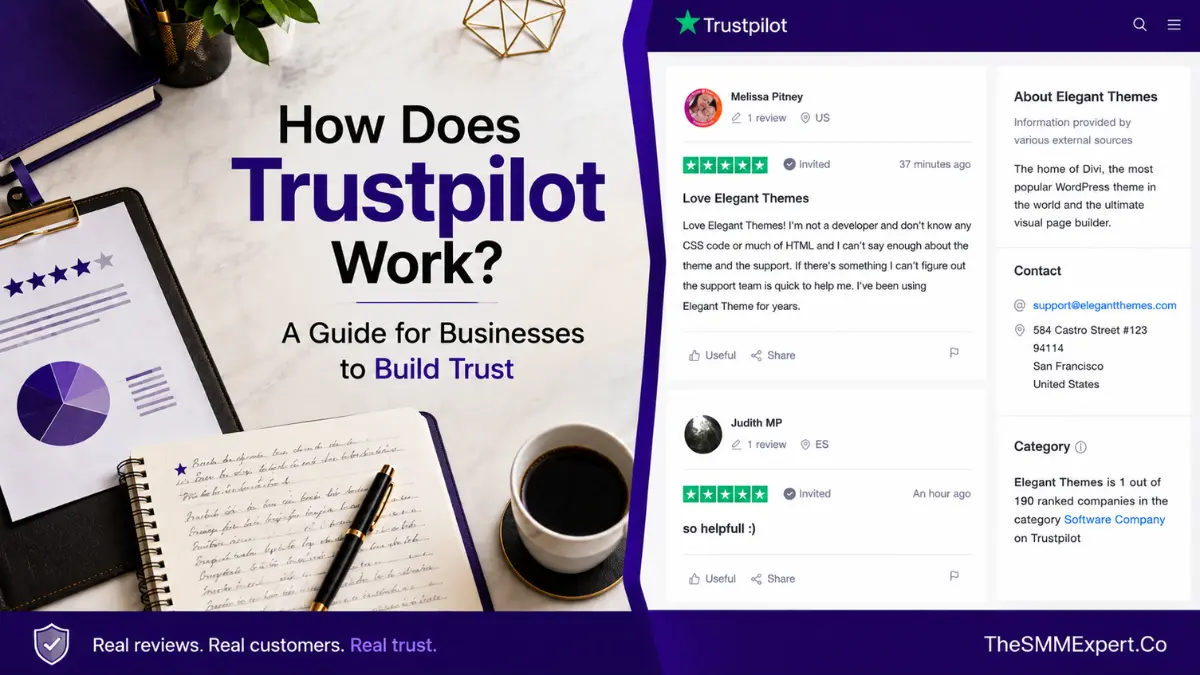
What Is Trustpilot and How Does It Work?
Trustpilot connects businesses with customer feedback.
Trustpilot is an independent customer feedback platform where customers can review businesses based on their genuine experiences, and businesses can build a brand image or reputation around the customer reviews and how the business or brand interacts with them.
It is an open review ecosystem where customers share their experiences, potential customers read the review collection to judge the brand’s credibility, and at the same time, the business can use the feedback to understand its brand image, trust score, social proof, and other metrics that make the business successful.
Customers leave reviews based on real experiences
Customers can leave Trustpilot reviews either after a purchase or service interaction or any other genuine experiences with a business. The reviews can be either organic or through a review invitation. These reviews usually include a written comment and a star rating that contributes to the business’s overall trust score.
Businesses can respond publicly to reviews.
Businesses with claimed Trustpilot profiles can reply to and engage with the public reviews to either thank satisfied customers who have left a good review or address complaints of a dissatisfied customer. This also acts as a way to show potential customers how responsibly the business handles feedback, earning consumer trust
How Businesses Collect Reviews on Trustpilot
Automatic review invitation emails.
Your business can collect reviews for its Trustpilot profile by sending out review invitations after a successful purchase or service experience with a customer. Trustpilot has an automatic feedback service system that can send verified service and product review invitations after genuine interactions with customers. This makes post-purchase email flows and review collection much easier.
Manual review request methods.
Your business can also use manual review request methods. These methods can include uploading customer data to send service review invitations. While manual review request methods are useful, automated review collection systems are usually better as they are easily scalable.
Website widgets and review integrations.
Your business can use Trustpilot widgets called TrustBox widgets to display its TrustScore, number of reviews, and select positive reviews on your website or marketing channels. Furthermore, e-commerce integrations such as WooCommerce allow merchants to trigger service and product review invitations automatically and place TrustBox widgets on key store pages.
Furthermore, with dot digital, businesses can automate customer Trustpilot reviews, while Klaviyo can help businesses feature their chosen Trustpilot reviews in email campaigns.
Along with the Trustpilot’s built-in tools, you can also get help from specialists like TheSmmExpert to make your review collection consistent.
How Trustpilot Ratings and TrustScore Work.
What the TrustScore means.
Your business’s TrustScore represents the overall measure of customer sentiment for your business on Trustpilot and directly affects the purchase decisions of potential customers.
It is presented on a scale of 1 to 5. According to Trustpilot, it is not simply an average of all reviews, but the calculation considers recency of reviews, time span, review frequency, and a Bayesian average, which is why ratings can fluctuate even if a business mostly receives positive feedback.
How star ratings are calculated
The star rating is a public star display connected to the score. Star ratings can fall into five different categories, such as bad, poor, average, great, and excellent. where a trust score of 1 to 1.7 is bad, 1.8 to 2.7 is poor, 2.8 to 3.7 is average, 3.8 to 4.2 is great, and finally 4.3 to 5 is excellent.
Factors that affect review visibility.
Review visibility on Trustpilot is only affected by the authenticity of the review and its conformity with the platform policies. The visibility is not affected at all by whether the review is positive or negative. All the reviews on Trustpilot are checked by an automated system before appearing publicly and may be removed if found to be breaching platform guidelines.
Why Trustpilot Matters for Businesses.
Builds customer trust before purchase.
With TrustPilot reviews, businesses can showcase their credibility and social proof to potential customers, influencing their purchase decisions. According to research, 99.75% online customers read reviews at least sometimes, and while 93% say ratings and reviews directly impact their purchase decisions. Since reviews influence buyer confidence, many businesses try to increase their Trustpilot reviews to improve credibility and revenue.
Improves conversion rates and click-through rates.
The number of reviews a business or brand has directly impacts customer conversion and purchase decisions, according to our research. A product with 5 reviews is 270% more likely to be purchased than a product with no reviews. According to Google, shop ratings on text ads can improve click-through rates on search by an average of 2%.
Strengthens SEO and brand credibility.
Trustpilot reviews can increase your business’s credibility on Google Search. With enough eligible reviews, Google can show the star rating in places such as search ads, shopping results, free listings, etc., which means that potential customers may see your business’s star rating without even needing to visit the website.
Provides customer insight for service improvement
With the help of transparent analytics, your business can monitor star ratings, star distribution, review volume, trust score, customer satisfaction trends, and search performance. With these insights, your business can focus on specific services to improve and strengthen customer retention to avoid losing existing and potential buyers, giving your business a competitive advantage.
How Businesses Can Use Trustpilot Strategically.
Display reviews across the customer journey.
Your business should not treat Trustpilot as only a review page, but utilize and showcase positive customer reviews as a part of a wider customer trust strategy by showing the review snippets on your business’s homepage, product pages, checkout pages, landing pages, abandoned cart emails, and all other important purchase points to reinforce the customer’s purchase decision.
Respond professionally to negative reviews
How your business handles negative reviews can also act as a major factor for potential customers when deciding whether to make a purchase decision from your business or not.
Your business must engage with all genuine reviews, whether positive or negative, for social proof optimization, and in case of negative reviews, the business must acknowledge the complaint in a professional manner and show empathy for the customer’s pain without being argumentative or defensive.
Use review insights to improve customer experience
Trustpilot is a major hub for your business for reputation monitoring and to gain insights regarding the customers. With Trustpilot’s analytics tools, your business can track its TrustScore, review volume, customer satisfaction trends, etc. This can help your business identify repeated complaints or problems and give a clear idea of where to focus and improve its customer experience management.
Integrate reviews into email marketing and retargeting
Your business can use positive reviews as part of review marketing campaigns. Trustpilot’s Klaviyo integration allows your business to feature Trustpilot reviews in welcome emails, abandoned cart emails, personalized messages, etc. Adding TrustScore to retargeting ads can increase click-through rates by up to 66%. This helps your business use social proof optimization beyond just your website and avoid losing your customers to competitors who have stronger review signals.
Common Trustpilot Mistakes Businesses Make
Ignoring negative reviews
How your business responds to negative reviews is often where potential customers judge your business. Ignoring negative reviews makes your business look careless and not appreciative of genuine customer feedback.
Requesting reviews inconsistently
Inconsistent review invitations can result in a weak review flow, make your business’s practices seem unreliable, and question the neutrality or fairness of the reviews you receive.
Violating Trustpilot review policies
Violating Trustpilot review policies can result in various consequences. Trustpilo can issue public warnings and place a consumer alert banner on a business’s profile to warn the customers that the business has violated Trustpilot’s guidelines.
Using fake or incentivized reviews
Trustpilot strictly prohibits the use of fake or incentivized reviews, which is a policy violation and can quickly result in declining customer confidence for the business.
Conclusion
Trustpilot helps businesses collect genuine customer experiences through customer reviews and engage with them publicly, building social proof and trust with potential buyers, influencing their purchase decisions.
If used properly, the platform becomes a wider customer trust strategy for credible businesses. Businesses can utilize Trustpilot to showcase their trust score, respond to customer feedback, and monitor their overall brand image while trying to improve as a whole. All of this depends on how each business utilizes the platform and whether their focus is actually on creating positive customer experiences or not.