On this page
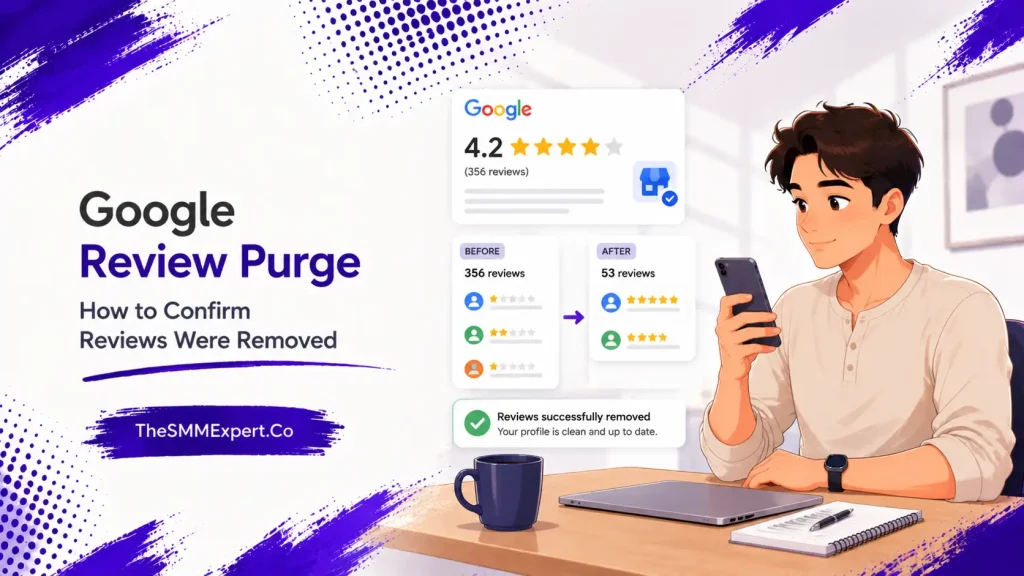
A Google review purge happens when automated spam filters suddenly remove a large batch of reviews from a business profile. It’s safe to keep your profile open and accept new feedback. Confirm the cause in under five minutes by checking Business Profile metrics for a sharp drop in total review count without matching customer deletions. If the number fell overnight without manual deletion, an automated sweep ran. This routine system cleanup targets patterns, not specific companies.
Why did my Google reviews disappear
Your missing feedback usually points to one specific trigger caught by the automated filter. The table below matches what you see on your profile with the reason behind it and your first move. Read down the left column until you find your exact situation.
| What you notice | What it usually means | What to do first |
|---|---|---|
| Total count dropped overnight | Automated spam filter ran | Check profile performance metrics |
| Only five-star reviews vanished | Rating manipulation detected | Stop any paid review services |
| Reviews from one country disappeared | Location mismatch flagged | Ask locals to rewrite naturally |
| Multiple reviews gone same minute | Bulk posting triggered limits | Space out future review requests |
| Text-only reviews removed | Spam pattern matched | Request detailed reviews next time |
| Reviewer profiles show as deleted | Fake accounts purged | Focus on verified past customers |
| Count drops after profile update | Re-indexing temporarily hides them | Wait 48 hours before escalating |
A sudden drop often hits businesses that send a review link through mass text messages or emails. Google flags identical links sent in rapid succession as coordinated activity. Send unique links instead, or ask customers to search your business name directly on Maps.
Reviews containing web addresses or phone numbers almost always get stripped automatically. Train your staff to remind customers to keep their feedback focused purely on their experience.
If your total count falls but no individual review looks missing, the filter likely suppressed entries still under evaluation. These typically reappear within three days if they pass inspection.
Never respond publicly to a disappearing review by arguing with the customer about it. That signals conflict to the algorithm and can invite deeper scrutiny of your entire profile.
The spam filter swept your profile
The automated spam filter is the single biggest reason behind a sudden drop in your review count. Google runs machine learning models constantly to scan every piece of feedback across its platform. These models look for patterns that real customers rarely produce. Learn more, why my Google reviews disappeared.
They flag identical phrasing across different accounts, bursts of reviews posted within minutes, or text that reads like copied marketing copy. When the system finds these signals, it removes the reviews instantly. There’s no warning email and no manual check beforehand.
You can confirm this happened by looking at your review velocity. Open your Business Profile dashboard and view your review history for the last 30 days. If you see a steep vertical drop on a single day while your daily average was steady before, the filter swept your page. This assumes you use a standard free Business Profile; if you manage locations through a third-party tool, check that tool’s sync logs first to rule out a display error.
The fix requires changing how you collect feedback going forward. Don’t ask fifty customers to leave a review on the same afternoon. Instead, send requests in small batches over several weeks. Tell customers to write about their specific experience using their own words. A review that mentions the name of the employee who helped or the exact item they bought passes the filter easily. Generic praise like “great service” repeated twenty times looks exactly like spam to the algorithm.
If you used a review generation service that promised fast results, stop using it immediately. Those tools often route customers through tracking links that the filter recognizes and blocks. You’ll lose those reviews again even if they get restored once.
You’ll know your changes worked when your new reviews stay visible for more than two weeks without disappearing. Watch the total count each Monday morning. If it holds steady or grows slowly, the filter accepts your new pattern.
This approach doesn’t help businesses that buy fake reviews intentionally. If you pay for feedback from strangers who never visited your location, the filter will always catch you eventually. No timing trick bypasses a system designed specifically to spot purchased engagement.
Reviewers broke the content policy
Content policy violations are the second most common reason reviews vanish during a sweep. This is completely different from the spam filter catching robotic patterns. Here, the problem lives inside the actual words, links, or context of what someone wrote. Real humans wrote these reviews, but they included something the rules strictly forbid.
Google prohibits reviews containing phone numbers, website URLs, promotional codes, or direct links to other pages. A customer trying to be helpful might paste your booking link into their five-star rating. The system strips that entire review the moment it detects the URL format. Profanity, personal attacks, or private information about employees also trigger instant removal.
To check for this, look at the reviews you remember losing. Did any of them contain a web address or a string of numbers? Did a customer mention another business by name to compare prices? If yes, the content itself caused the deletion. You can verify this by reading Google’s prohibited content policies to see the exact formats that trigger automatic removal.
The solution is guiding your customers before they type. When you ask for a review, add one simple sentence: “Please don’t include links, phone numbers, or names of our staff.” That single instruction prevents the most frequent policy violations. You don’t need to read their draft or approve it first. Just setting the boundary keeps the text clean enough to survive the scan.
You can tell this apart from a spam sweep because the loss is scattered. A spam filter often wipes out dozens of reviews at once based on timing. Policy violations usually take out one or two reviews at a time, spread across different days, whenever someone breaks a specific rule. Your total count dips slightly rather than crashing.
You’ll know you’ve fixed it when newly posted reviews containing only plain text remain permanently on your profile. If a customer writes three sentences about the food they ate without adding a link or a phone number, that review stays. The absence of restricted elements is your confirmation.
Suspicious IP addresses triggered removal
Reviews submitted from suspicious networks form the third and least common reason for a disappearance. This has nothing to do with what the customer wrote or how fast they typed it. The issue is where the signal came from. The system checks the internet connection used to post the feedback.
If multiple reviews originate from the same public Wi-Fi network, a known data center, or a virtual private server, the system flags them. Businesses sometimes set up an iPad in their lobby for customers to use. Every review typed on that device shares one IP address. The algorithm sees ten reviews from one connection and assumes one person faked them all.
To confirm this, think about how your customers actually submit their feedback. Do they use your guest Wi-Fi? Do you hand them a shared tablet? If you lost reviews shortly after setting up an in-store kiosk, the shared network is your culprit. The exact threshold varies depending on your industry’s typical traffic volume, so check your router’s connected device logs to see how many submissions share one address.
The fix is asking customers to use their own cellular data. Tell them to turn off Wi-Fi on their phones before opening the review page. If you must provide a device, understand that using any shared network carries significant risk of removal; relying on customers’ personal devices and cellular data is far safer. Never route review traffic through a proxy server.
You distinguish this from the first two causes by looking at the source, not the text. Spam filters target posting speed. Policy filters target forbidden words. Network filters target the connection itself. Your reviews might be perfectly written and spaced out, yet still vanish if they all came from your lobby router.
You’ll know the network was the problem when reviews submitted via mobile data stay visible while those from your store’s Wi-Fi continue to drop. Switch your request method entirely to personal devices. Once you stop funneling traffic through a single point, the remaining reviews will hold their place.
When to call support about missing reviews
You can handle most drops by adjusting your collection methods. But some situations cross the line where self-correction stops working. Pushing further on your own risks wasting weeks or triggering deeper scrutiny on a healthy profile. Stop trying to fix it yourself if you see these signs:
- Your count dropped to zero overnight. A complete wipe suggests a profile-level suspension rather than a standard sweep, which requires official reinstatement steps you can’t perform alone.
- Legitimate reviews from long-time customers vanished. If people who actually bought your product months ago lose their posts, the filter made an error that only manual review can correct.
- New reviews disappear within seconds of posting. This indicates your profile is currently shadow-restricted, meaning every submission fails regardless of how carefully the customer writes it.
- You received an email about a policy violation. Written warnings mean a human reviewer looked at your account, and responding incorrectly can lead to permanent removal.
- Competitors are visibly mass-reporting your page. Coordinated false reporting requires platform intervention to separate genuine abuse from your real feedback.
The limit here is clear: the time it takes for a legitimate review to stick to your profile after you change your collection method tells you if the restriction has lifted. If that wait exceeds 14 days, the block remains active.
At that point, you need to contact Google Business Profile support directly. Navigating the appeals process for a restricted account requires understanding the specific enforcement action applied to your listing. Attempting to bypass this by creating a new profile violates terms of service and leads to permanent bans across your accounts. Let the support team handle the technical lift.
Conclusion
A sudden loss of feedback feels alarming, but it’s rarely a permanent punishment. The system simply enforces its standards automatically. By spacing out your requests, avoiding shared networks, and reminding customers to skip links, you align your profile with what the filter expects. Watch your count stabilize over the next few weeks, and let genuine customer experiences rebuild your reputation naturally.
Frequently asked questions
How long does a review sweep take?
You won’t see a slow decline over a week. The count drops sharply on a single day. For a standard local business profile, removal can occur rapidly when the automated model detects violating patterns. If your count is still falling gradually after three days, you’re likely dealing with individual policy violations rather than a system-wide sweep.
Can I get my removed reviews back?
No, you can’t manually restore reviews deleted by the spam filter. The system removes them permanently once it confirms they violate its parameters. Submitting a support ticket only works if the filter made a verifiable error, such as removing a detailed review from a confirmed buyer. Even then, restoration takes several weeks. Focus your energy on collecting fresh, compliant feedback instead of fighting for lost posts.
Why did only my five-star reviews disappear?
Losing only positive ratings usually means the system detected artificial inflation. If you recently ran a campaign offering discounts in exchange for high scores, the filter recognized the resulting pattern. Genuine one-star complaints from angry customers rarely match spam signatures, so they survive the sweep. To prevent this, never tie incentives to specific star ratings. Ask for honest feedback without directing the score.
Is it safe to ask for reviews right now?
Yes, it’s completely safe to keep requesting feedback while a sweep happens. Pausing your collection efforts actually hurts your profile’s momentum. However, you must change how you ask. Stop sending bulk emails or SMS blasts. Switch to verbal requests made individually at the point of sale. Keep your volume consistent with your actual customer traffic until your total count stabilizes for at least 14 consecutive days.
What happens if I buy reviews after a purge?
Buying reviews after a purge guarantees another immediate removal. Your profile is already flagged for unusual activity, meaning the algorithm monitors your incoming data much more closely than a standard account. Purchased feedback comes from networks the system already blacklists. You’ll lose the money spent, face a potential profile suspension, and damage your search visibility. Stick to organic requests from verified customers who physically visited your location.
Does a purge hurt my local search ranking?
Yes, a sudden drop in review count negatively impacts your local search position. The ranking algorithm relies heavily on total volume and recent activity. Losing 30 reviews in one day signals reduced popularity to the system. Your ranking will likely fall within the local map pack. Recovery depends entirely on how quickly you replace the lost volume with genuine, high-quality feedback over the following weeks.
How often does the filter run?
The automated filter runs continuously rather than on a set monthly schedule. Machine learning models evaluate new reviews the moment they’re published. Larger systemic sweeps targeting widespread spam networks happen periodically, often aligning with core algorithm updates. You won’t receive advance notice. Monitor your review count weekly to catch sudden drops early. If your industry faces heavy spam, expect more frequent evaluations of your profile.
Do replies to reviews get deleted too?
No, your responses to customer feedback aren’t targeted by the spam filter. If a customer’s review gets removed, your reply disappears with it because the parent post no longer exists. However, standalone replies you leave on surviving reviews stay intact. Writing thoughtful responses to legitimate reviews actually helps your profile. It signals active management to the algorithm, which builds trust and protects your remaining feedback from future sweeps.
 Written byAbdul HalimAbdul Halim writes about online reputation management and the challenges businesses face when trying to build trust online. His content covers customer feedback, online reviews, how people see brands, reputation monitoring, negative feedback, and ways to maintain a strong online presence. Abdul shares simple steps businesses can use to learn what customers say, respond to reputation concerns, build credibility, and earn lasting trust. He wants to help people understand reputation management more easily and give businesses ideas for keeping and growing their online reputation.LinkedIn