On this page
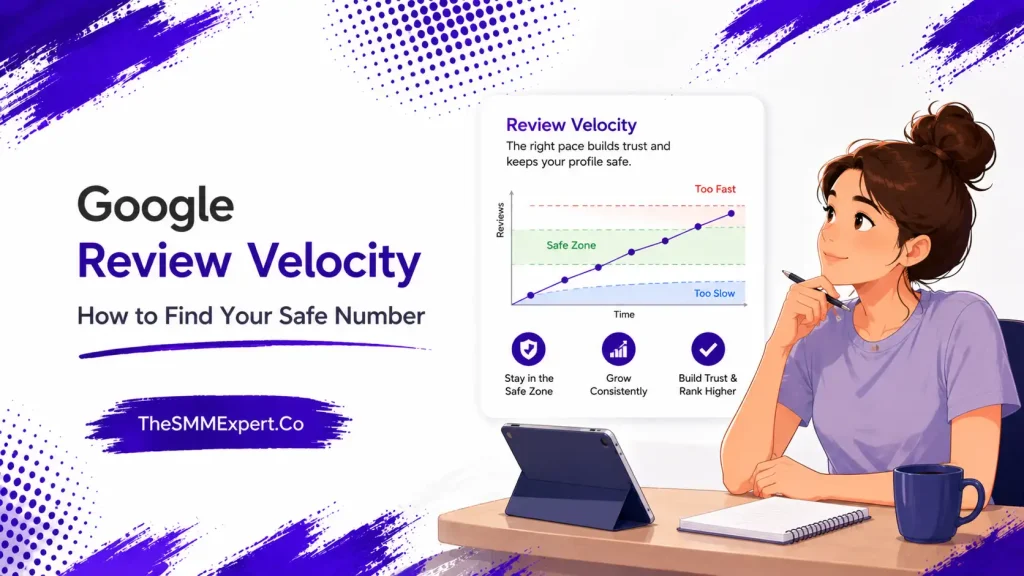
The safe number for google review velocity scales with your actual customer volume.
How fast should Google reviews come in
The right pace depends entirely on how many real transactions you complete. A shop serving ten people daily shouldn’t see fifty new ratings overnight, but a clinic booking hundreds of appointments weekly might earn them naturally. Match the incoming rate to your foot traffic or sales count.
| How you use it | How often | What tells you it’s due |
|---|---|---|
| Under 10 customers daily | 1 to 3 weekly | Fewer than 5 new monthly |
| 10 to 50 customers daily | 3 to 7 weekly | Steady trickle stops completely |
| 50 to 100 customers daily | 7 to 15 weekly | Weekly total drops below 5 |
| Over 100 customers daily | 15 to 25 weekly | Daily average falls below 2 |
| New location, first month | 2 to 5 weekly | Zero feedback after 14 days |
| Seasonal peak, high traffic | Up to 30 weekly | Pace matches your busiest days |
What happens when reviews arrive too fast
A sudden flood of new ratings triggers automated spam filters before a human ever looks at your profile. The system compares today’s pace against your history. If you went from two a month to twenty a week, the algorithm treats the change as suspicious activity rather than organic growth. That’s the first thing that shifts, and it happens within hours of the spike.
Once flagged, your newest entries get held back. They won’t show up publicly right away. You’ll still see them if you’re logged into the business account, but potential customers searching your name won’t. This shadow-filtering phase usually lasts a few days while the system decides whether the pattern is real.
If the unusual pace continues past that window, the platform may remove the batch entirely. You won’t get an email explaining why specific entries vanished. They simply disappear from your public count. Your overall star rating recalculates without them, which often means dropping a fraction of a point overnight.
After weeks of repeated spikes, the damage reaches your search visibility. Your business listing stops appearing in the map pack for terms you used to rank for. Local ranking relies heavily on consistent signals, and erratic feedback patterns tell the algorithm your profile isn’t trustworthy. You lose the placement you spent months building.
At the extreme end, persistent manipulation leads to a full suspension. Your listing goes dark. Nobody finds you through maps or local search until you file an appeal and prove the activity was legitimate. Reinstatement takes time, and there’s no guarantee it works.
This path isn’t for businesses running short promotional campaigns expecting instant reputation boosts. Paid blasts or contest-driven rushes create exactly the spikes that trigger these penalties.
The trade-off here is patience versus speed. Growing slowly keeps your profile safe, but it takes longer to build social proof. Rushing the process risks losing everything you’ve gained. Check your own baseline by looking at your profile’s history tab inside Business Profile Manager — your past monthly totals are the only honest guide for what your next month should look like.
That document defines what crosses the line.
Signs your review pace triggered a filter
New entries stay invisible to the public for over 48 hours. This delay means the spam filter holds them for inspection instead of publishing normally.
Your total count dropped without you deleting anything yourself. Removed entries indicate the system identified a pattern violation and purged the batch retroactively. Check your email for a specific removal notice to distinguish this from routine quality filtering.
You fell out of the local map pack for branded searches. Ranking loss tied to feedback anomalies shows the algorithm downgraded your trust score temporarily. Competitors with steady review velocity will occupy those top three spots until yours stabilizes.
Star rating fluctuates wildly within a single week. Erratic scoring happens when large batches appear and vanish unpredictably across short windows. Genuine organic growth produces gradual shifts rather than sudden vertical jumps or drops on your chart.
Customers confirm they posted feedback you can’t find anywhere. Missing submissions mean the platform blocked them at entry based on velocity rules.
Your Business Profile dashboard shows a policy warning banner. Direct notifications confirm the system detected suspicious activity requiring immediate correction. Ignoring this alert extends the restriction period significantly beyond the initial penalty window.
Treat missing analytics as a secondary confirmation that your account is currently under manual review.
Time and effort each round requires
Earning feedback at a natural pace asks for a repeatable habit, not a one-time push. You don’t need software or agencies. You need a moment built into every finished transaction.
For a physical store, this means asking verbally right after payment. It takes about 10 seconds per customer. If you serve 30 people a day and ask each one, you might hear back from 3 or 4. That gives you roughly 15 to 20 a week, which fits a high-traffic retail spot perfectly.
For service businesses working remotely, the request goes out via text or email after the job closes. Drafting a short message with a direct link takes under five minutes once. Sending it adds maybe 30 seconds to your wrap-up routine per client. If you close 10 jobs weekly, expect 2 or 3 responses.
The cost isn’t money. It’s consistency. You have to train whoever handles checkout or project sign-off to make the ask every single time. Skipping days creates gaps, and filling those gaps later with rushed requests causes the exact spikes we discussed earlier.
New hires often forget during rush hours unless the prompt is physically attached to the point-of-sale terminal. A sticky note on the card reader works better than verbal reminders because it triggers the action automatically during peak stress.
You also need to spend time replying. Answering each new entry takes 2 to 3 minutes. Ignoring them doesn’t affect velocity directly, but it lowers the conversion rate of future requests. Customers notice when a business never responds.
Track your numbers weekly. Open your profile manager, note the total, and subtract last week’s figure. That difference is your current pace. Compare it against your transaction count. If you completed 50 jobs but only got 1 rating, your process has a leak. Fix the ask before trying to scale it.
A healthy ratio sits between five and ten percent for most local service providers. Falling below three percent usually indicates a broken link or an overly complicated review form rather than customer apathy. Test the link yourself on a mobile device monthly to ensure it still opens correctly.
Don’t batch your outreach. Sending 100 links on Monday after a quiet weekend creates an artificial surge. Spread requests evenly across your operating days. Even distribution keeps you under the radar while building steady momentum.
Habits that keep your pace natural
-
Send requests immediately after the transaction finishes. Waiting even 24 hours drops response rates sharply, forcing you to send larger batches later to hit the same target.
-
Spread outreach evenly across all business days. Concentrating asks on Mondays creates weekly spikes; daily distribution mimics genuine customer behavior patterns.
If your busiest day is Saturday, don’t save those requests for Monday morning. Send them Sunday evening instead. Platforms track the gap between purchase and review request. A two-day delay looks like a coordinated campaign rather than routine follow-up.
- Tie request volume directly to completed sales counts. Never ask more people than you actually served, because mismatched ratios signal artificial inflation to automated filters.
A safe ceiling is one request per unique order number. Asking both the billing contact and the shipping recipient for the same order creates a duplicate flag.
- Use direct profile links instead of generic search instructions. Reducing friction increases organic response rates naturally, eliminating the need for aggressive follow-up campaigns.
Test every link on a cellular connection before sending it out. Links that load fast on office Wi-Fi often stall on mobile data, and most customers abandon the page after three seconds.
- Train staff to ask verbally rather than relying solely on automation. Human interaction produces staggered timing that algorithms recognize as authentic compared to identical automated timestamps.
Start tracking your review pace today
Open your Business Profile Manager right now and write down your total count from the last four weeks. Divide that number by four to find your current weekly average.
Next week, match your outgoing requests to your actual completed transactions so the incoming pace stays near that average. If you close ten deals a week, send exactly ten requests.
Don’t batch them all on Monday morning. Spread them evenly across the days you actually deliver work. Batching creates spikes the system flags as unnatural behavior.
Within 14 days, you’ll see new entries publish without delay, and your star rating will hold steady instead of jumping around. That stability is the sign the filters trust your profile again.
If your count drops suddenly or entries vanish overnight despite keeping your pace even, stop sending requests and contact platform support directly. Don’t try to compensate by pushing out extra links.
Frequently asked questions
Can I buy reviews safely?
No, purchasing them violates platform policies and almost always triggers velocity alerts. Sellers deliver batches simultaneously, creating unnatural spikes that automated systems detect within hours. Beyond removal risk, paid entries frequently come from accounts already flagged for suspicious behavior. This association damages your profile’s trust score further. Legitimate growth requires actual customer experiences shared voluntarily over time. There’s no shortcut that avoids detection permanently.
Why did my new reviews disappear?
They were likely filtered out due to an abnormal submission rate or suspicious reviewer profiles. When multiple entries arrive faster than your historical average allows, the system holds or removes them automatically. Other causes include reviewers using the same IP address or leaving identical phrasing across different businesses. Check your profile manager for policy warnings. If none exist, wait several days; some filtered entries reappear after secondary review completes successfully.
How long does a penalty last?
Minor filtering resolves within 3 to 7 days if the unusual activity stops immediately. Severe suspensions require formal appeals and typically take 2 to 4 weeks for reinstatement decisions. During this period, your listing remains hidden from public search results. Recovery speed depends on whether you can prove the flagged activity involved real customers. Repeat violations extend timelines significantly and may result in permanent removal without further appeal options.
Is it safe to run a contest for feedback?
No, offering incentives for ratings directly violates platform terms regardless of contest structure. Incentivized campaigns generate concentrated bursts of activity that mirror spam patterns exactly. Even if participants leave honest opinions, the coordinated timing triggers automated defenses. Businesses caught running these promotions face entry removal and potential profile suspension. Organic growth strategies remain the only compliant approach for building lasting reputation safely.
What happens if competitors spam my profile?
Competitors submitting fake negative entries rapidly can trigger the same velocity filters meant to catch manipulation. The system may temporarily restrict your profile while investigating the anomaly. Document suspicious patterns with screenshots showing timestamps and reviewer histories. Report coordinated attacks through official support channels immediately. While investigations proceed, avoid launching defensive campaigns that add more unusual activity to an already flagged timeline.
Does responding to reviews affect velocity?
Replying doesn’t change how fast new entries arrive or get processed. However, active responses improve overall engagement metrics that influence local search visibility independently. Profiles with consistent owner replies tend to convert browsing customers into reviewers at higher natural rates. Focus on thoughtful answers rather than quick acknowledgments. This builds genuine rapport that encourages future voluntary feedback without manipulating submission timing artificially.
How many reviews per day is too much?
More than 5 daily for a small business averaging under 20 transactions raises red flags. High-volume locations handling hundreds of interactions daily might sustain 10 to 15 safely. The threshold moves with your verified customer count. Exceeding your normal ratio consistently invites scrutiny. Monitor your weekly totals against foot traffic data to establish your personal ceiling accurately.
Do old reviews matter for velocity checks?
Yes, the system calculates acceptable speed based on your entire historical pattern. A profile with thousands of entries accumulated over years tolerates slightly faster recent growth than a brand-new listing. Sudden acceleration on established accounts still triggers alerts if the change lacks corresponding business expansion evidence. Your baseline forms gradually, making consistency more valuable than occasional impressive surges.
 Written byAbdul HalimAbdul Halim writes about online reputation management and the challenges businesses face when trying to build trust online. His content covers customer feedback, online reviews, how people see brands, reputation monitoring, negative feedback, and ways to maintain a strong online presence. Abdul shares simple steps businesses can use to learn what customers say, respond to reputation concerns, build credibility, and earn lasting trust. He wants to help people understand reputation management more easily and give businesses ideas for keeping and growing their online reputation.LinkedIn