On this page
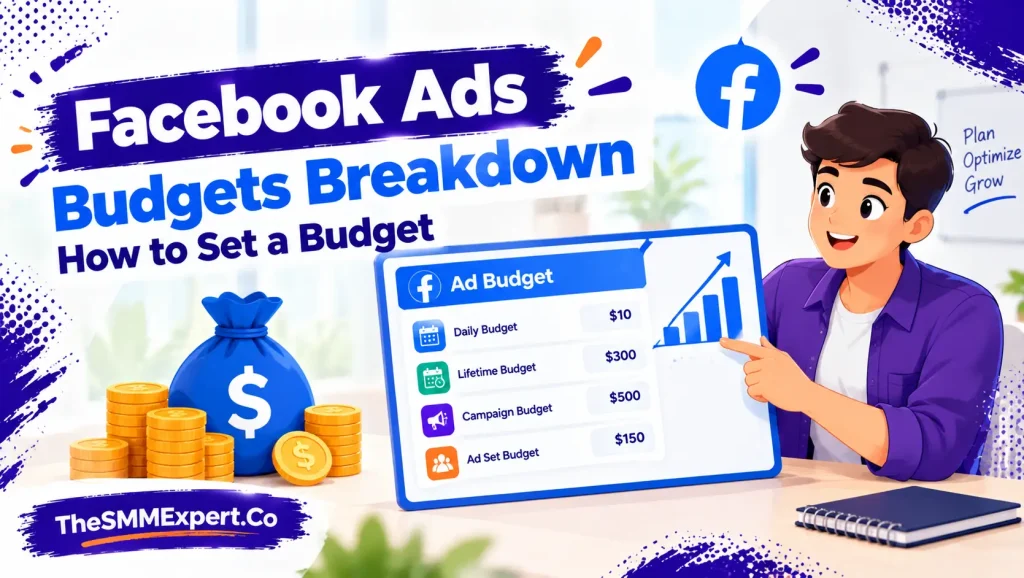
Facebook ad budgets commonly start around $10–$50 per day for testing, $300–$1,500 per month for a small business, and $3,000–$30,000 or more per month for a serious growth campaign. Your actual Facebook ads budget breakdown depends on audience size, objective, creative quality, industry competition, conversion rate, and the revenue or leads you need.
Key Takeaways
- Start with $10–$50 per day for a controlled test instead of committing your entire budget immediately.
- Reserve roughly seventy to eighty percent for proven campaigns and twenty to thirty percent for testing new audiences, offers, and creative.
- Track cost per result, not just clicks, impressions, or likes.
- Give each campaign enough budget to generate meaningful conversion data before making major changes.
- Increase spending gradually, usually by roughly twenty to thirty percent at a time, when results remain profitable.
- Keep a separate creative budget because ad fatigue can raise costs even when targeting is sound.
What Facebook Ads Cost
Facebook doesn’t charge a universal fixed price for an impression, click, lead, or purchase. Instead, most placements use an auction. Advertisers compete for opportunities to show ads to people who match their targeting, and the final cost changes according to demand and estimated ad performance.
Typical planning ranges look like this:
| Cost measure | Typical range | What it tells you |
|---|---|---|
| Cost per thousand impressions | $5–$30 | The price of reaching a thousand impressions |
| Cost per click | $0.50–$3.50 | The average price of a link click |
| Cost per landing-page view | $0.75–$5.00 | The cost of a person who loads your page |
| Cost per lead | $5–$50 | The cost of a completed inquiry or form |
| Cost per purchase | $20–$150 or more | The cost of a tracked conversion |
These are planning ranges, not guarantees. A local service company may see lower costs with a focused audience, while a competitive ecommerce category can pay considerably more for the same type of result.
Meta describes its ad auction as considering factors such as the advertiser’s bid, estimated action rate, and ad quality. You can review the platform’s explanation of the Meta ad auction when deciding why two campaigns with similar budgets produce different delivery and costs.
What changes your price?
Several variables influence delivery:
- Campaign objective: Sales and lead campaigns often cost more than reach or video-view campaigns because they seek a harder-to-achieve action.
- Audience competition: Finance, legal services, insurance, real estate, health products, and business software commonly attract aggressive bidding.
- Geography: Major US cities can cost more than smaller markets because more advertisers compete for the same users.
- Placement mix: Instagram Feed, Facebook Feed, Stories, Reels, and Audience Network can produce different costs and conversion quality.
- Ad quality: Clear, relevant creative can improve delivery, while misleading or repetitive ads can reduce efficiency.
- Conversion friction: A long form, slow website, unclear offer, or complicated checkout can increase cost per result.
A low cost per click isn’t automatically good. If cheap clicks never become leads or customers, the campaign is still expensive.
Choose Your Budget Model
You can set budgets at the campaign level or the ad-set level, depending on how much control you want over audience and placement spending.
Daily budgets
A daily budget tells Meta the average amount you want a campaign or ad set to spend per day over time. Daily delivery may fluctuate, particularly when the system sees an opportunity to obtain more results, so monitor the total spend over your chosen billing period rather than judging a single day.
Daily budgets work well when you want:
- Steady pacing for an ongoing local campaign.
- Simple management for a small business.
- Continuous lead generation with no fixed end date.
- Flexible scaling after finding a profitable audience.
A practical starting schedule might look like this:
| Business situation | Starting daily budget | Useful objective |
|---|---|---|
| Local service testing | $10–$25 | Leads or messages |
| Small ecommerce test | $20–$75 | Sales |
| Established local promotion | $50–$150 | Leads or sales |
| Regional growth campaign | $150–$500 | Sales or qualified leads |
Lifetime budgets
A lifetime budget sets a maximum amount for a campaign over a defined start and end date. Meta can shift spending toward days, times, or placements where it expects stronger performance.
Lifetime budgets are useful for:
- Seasonal promotions such as holiday offers.
- Event registration with a known deadline.
- Product launches with a fixed promotional window.
- Short retargeting campaigns after a major website event.
Use a lifetime budget when timing matters more than perfectly even daily spending. A daily budget is usually easier when you need consistent lead volume.
Campaign versus ad-set budgets
Campaign budget optimization allows Meta to distribute funds among ad sets. Ad-set budgets give you more control over how much each audience receives.
| Budget method | Best for | Main advantage | Main limitation |
|---|---|---|---|
| Campaign budget | Similar audiences and shared objective | Moves money toward stronger opportunities | May underfund a smaller audience |
| Ad-set budget | Deliberate audience testing | Makes comparisons easier | Can force spend into weak segments |
| Lifetime campaign budget | Fixed promotions | Uses timing and delivery flexibility | Requires a clear end date |
| Daily ad-set budget | Controlled experiments | Keeps test spend predictable | Less efficient if results vary widely |
Pro Tip: Use ad-set budgets during an initial audience test when you need a fair comparison. After identifying a reliable audience, a campaign-level budget can often improve allocation by allowing the system to prioritize stronger opportunities.
Build a Facebook Ads Budget Breakdown
A useful budget isn’t just a spending limit. It’s a plan for distributing money across the customer journey, testing, creative production, and measurement.
A general starting allocation might be:
| Budget category | Typical share | Purpose |
|---|---|---|
| Prospecting | 50%–70% | Reach people unfamiliar with your business |
| Retargeting | 10%–25% | Re-engage visitors, viewers, and engagers |
| Creative testing | 10%–20% | Test hooks, formats, offers, and visuals |
| Measurement and contingency | 5%–10% | Cover tracking checks and unexpected changes |
These percentages should change according to your funnel. A new brand with little traffic may need more prospecting. A business with substantial website traffic may get stronger returns from retargeting, although a small retargeting pool can’t absorb unlimited spend.
Prospecting budget
Prospecting campaigns reach people who haven’t recently interacted with your company. Common audiences include broad targeting, interest groups, lookalike audiences, and location-based groups.
Spend more here when you need:
- New customer growth
- Larger remarketing pools
- Brand awareness
- Consistent sales volume
Prospecting usually needs stronger creative because the audience has less context. Explain the problem, show the product or service clearly, and provide a reason to act.
Retargeting budget
Retargeting reaches people who have already watched a video, visited a website, opened a form, added an item to a cart, or engaged with your social profile.
Retargeting often produces efficient results, but the audience is limited. Overfunding it can lead to repetitive impressions and rising frequency. Use shorter windows for urgent offers and longer windows for considered purchases.
Useful retargeting segments include:
- Product viewers
- Cart abandoners
- Lead-form openers
- Video viewers
- Instagram engagers
- Past customers
Exclude people who already purchased when the offer is intended for new customers. Otherwise, part of your budget may promote an acquisition message to someone who has already converted.
Creative testing budget
Set aside money for creative tests rather than changing the entire campaign whenever performance weakens. Test specific variables:
- Opening hook
- Headline
- Offer
- Image
- Short video
- Customer problem
- Call to action
- Proof point
One test should have a clear question. For example, compare a price-led message with a convenience-led message while keeping the audience and landing page consistent.
Set A Starting Budget
The right starting amount depends on your conversion economics, not on an arbitrary minimum. Begin with the result you need, then work backward from an acceptable cost.
Suppose a service business can accept a lead at up to $40 and wants roughly ten leads during an initial learning period. A reasonable test budget could be around $400–$600. That amount isn’t a promise of ten leads; it simply creates a budget large enough to evaluate whether the campaign is near the business’s target.
For ecommerce, start with the maximum cost per purchase you can support. If your contribution margin allows a $60 acquisition cost, a test might use approximately $600–$1,200 before a major decision, depending on traffic quality and conversion volume.
Use your target cost
Calculate the following:
- Average order value: What customers pay before refunds and discounts.
- Gross margin: What remains after product and fulfillment costs.
- Break-even acquisition cost: The most you can spend to acquire a customer without losing money.
- Target acquisition cost: A safer amount below break-even.
- Expected conversion rate: The percentage of qualified visitors who purchase or submit a lead.
- Required traffic: The number of visitors needed to produce the desired results.
For example, if a landing page converts at roughly two to five percent and you need around twenty leads, you may require approximately four hundred to one thousand qualified visitors. If your landing-page-view cost is around $1–$5, the required traffic could cost roughly $400–$5,000. The broad range shows why funnel performance matters more than the ad budget alone.
Match budget to audience size
A huge budget aimed at a small local audience can create frequency problems. A tiny budget aimed at a national audience may produce too little data to optimize.
| Audience situation | Suitable budget approach | Watch closely |
|---|---|---|
| Small local service area | $10–$50 daily | Frequency and lead quality |
| Niche professional service | $20–$100 daily | Audience saturation |
| Regional ecommerce | $50–$300 daily | Purchase volume |
| National consumer product | $100–$1,000 daily | Creative fatigue and margin |
| B2B lead generation | $50–$500 daily | Qualification rate |
These are broad starting ranges. A business should adjust them after checking actual conversion quality, not simply after observing a few cheap clicks.
Allocate By Funnel Stage
Budget allocation should reflect how people move from discovery to purchase. The most useful funnel stages are awareness, consideration, conversion, and retention.
Awareness
Awareness campaigns introduce your business to potential customers. They may optimize for reach, video views, or engagement. These objectives can be helpful when your product requires education, but they don’t directly prove that people will buy.
Allocate more toward awareness when:
- Your brand is new
- Your sales cycle is long
- Your category needs explanation
- You lack remarketing volume
Judge awareness by qualified reach, video engagement, branded searches, assisted conversions, and the growth of audiences that you can later retarget.
Consideration
Consideration campaigns encourage people to visit your website, read an explanation, compare options, or start a conversation. Traffic and engagement can be useful, but confirm that visitors are relevant.
Good consideration creative can include:
- Demonstration videos
- Comparison guides
- Problem-solution carousels
- Customer testimonials
- Educational lead magnets
- Frequently asked questions
Don’t assume a high engagement rate means high purchase intent. Someone can watch a video or comment without being a realistic customer.
Conversion
Conversion campaigns focus on leads, purchases, registrations, calls, or messages. They require accurate event tracking and a clear offer.
Conversion budgets work best when:
- The pixel or dataset receives reliable events
- The landing page loads quickly
- The offer is easy to understand
- The checkout or form works on mobile
- Sales follow-up is fast
If conversion volume is too low, the system may have limited signals. You may need to improve creative, broaden the audience, simplify the funnel, or temporarily optimize for a higher-volume event.
Retention
Retention campaigns target customers who have already purchased or subscribed. They can promote replenishment, upgrades, referrals, or complementary products.
Keep retention separate when possible so you can distinguish:
- New customer acquisition
- Repeat purchases
- Upsells
- Cross-sells
- Win-back campaigns
The acceptable cost for a repeat purchase may be lower than the cost for a first purchase because you already paid the initial acquisition cost and have an existing relationship.
Test Without Wasting Money
Budget testing should answer questions while limiting unnecessary spending. Avoid launching many tiny ad sets that each receive too little delivery.
Test one major variable
Compare one meaningful difference at a time:
- Offer A versus Offer B
- Video versus static image
- Broad audience versus lookalike
- Short form versus long form
- Benefit-led copy versus feature-led copy
If the audience, creative, landing page, and offer all change at once, you won’t know what caused the result.
Give tests enough time
Don’t stop an ad because one morning is expensive or one evening is unusually strong. Allow enough time for delivery patterns to emerge. A small business may need several days or longer, depending on budget, audience size, and conversion volume.
Use a decision framework:
| Signal | Possible meaning | Action |
|---|---|---|
| Low impressions | Audience or bid limitation | Broaden targeting or placements |
| High impressions, few clicks | Weak hook or poor relevance | Refresh creative |
| Many clicks, few page views | Slow or broken landing page | Check speed and tracking |
| Many page views, few leads | Offer or form problem | Improve page and qualification |
| Leads but no sales | Poor qualification or follow-up | Review sales process |
| Rising frequency and costs | Audience fatigue | Add creative or expand audience |
Warning: Don’t solve every performance problem by increasing the budget. More spending can amplify a weak offer, broken tracking, poor follow-up, or low-quality traffic.
Know when to pause
Pause or revise an ad when it consistently fails against your target after receiving enough relevant delivery. Useful warning signs include:
- Cost per result well above your target.
- Low click-through rate compared with your other ads.
- High frequency paired with declining response.
- Poor lead quality despite acceptable cost.
- Broken tracking or missing conversion events.
- Negative comments that reveal a genuine offer problem.
Keep a record of what you changed and when. A simple change log prevents random decisions and helps identify patterns.
Scale A Winning Campaign
Scaling means spending more while preserving acceptable economics. It isn’t merely turning up the budget.
Increase gradually
Increase a stable campaign by roughly twenty to thirty percent, then observe delivery and conversion quality. Larger changes can disrupt the system’s current allocation or cause it to search for a broader, less efficient pool of opportunities.
A gradual scaling sequence might look like:
| Stage | Daily budget range | Decision |
|---|---|---|
| Initial test | $10–$50 | Confirm tracking and basic demand |
| Early winner | $50–$150 | Increase while monitoring cost |
| Proven campaign | $150–$500 | Add creative and audience depth |
| Mature campaign | $500–$2,000 or more | Manage margins and fatigue |
There’s no universal ceiling. Your limit is determined by audience size, conversion capacity, inventory, customer support, and profitable demand.
Scale horizontally
Horizontal scaling means adding new opportunities rather than repeatedly increasing one ad set. Consider:
- New creative concepts
- Broader targeting
- Additional geographic areas
- Lookalike audiences
- New placements
- Different offers
- Separate product categories
Horizontal scaling can reduce reliance on one audience or one winning ad. However, launch additions carefully so you don’t create unnecessary overlap or compete against your own campaigns.
Protect profitability
A campaign may produce more conversions while becoming less profitable. Watch:
- Blended acquisition cost
- Contribution margin
- Return on ad spend
- Refund rate
- Lead-to-sale rate
- Average order value
- Customer lifetime value
For lead generation, connect advertising results to closed revenue whenever possible. A $20 lead isn’t necessarily better than a $40 lead if the cheaper leads never become customers.
Track The Right Metrics
The correct metric depends on the business objective. Use a small set of primary and diagnostic metrics rather than reacting to every number in Ads Manager.
Primary metrics
- Purchases: Completed transactions attributed to the campaign.
- Qualified leads: Leads that meet your customer criteria.
- Cost per result: Spend divided by the chosen result.
- Return on ad spend: Revenue attributed to ads divided by ad spend.
- Revenue per lead: Closed revenue divided by leads generated.
Diagnostic metrics
- CPM: Indicates auction pressure and audience cost.
- Click-through rate: Indicates whether the creative earns attention.
- Cost per click: Helps identify ad and audience efficiency.
- Landing-page-view rate: Shows whether clicks become page visits.
- Conversion rate: Shows how effectively the page turns visitors into results.
- Frequency: Shows how often people see your ads.
A helpful calculation is:
Cost per customer = cost per lead ÷ lead-to-customer rate
If leads cost $20–$40 and roughly ten to twenty percent become customers, the resulting customer acquisition cost can range from about $100–$400. That figure may be acceptable for a high-margin service and unacceptable for a low-margin product.
Check attribution carefully
Platform-reported conversions can differ from analytics platforms, customer relationship management systems, and payment records. Differences can come from attribution windows, privacy restrictions, delayed conversions, duplicate events, and different definitions of a conversion.
Use a consistent primary reporting method. Then compare the platform’s numbers with actual purchases, booked appointments, or qualified sales outcomes.
Fix Common Budget Problems
Budget problems often look like advertising problems but originate elsewhere.
Spending is too slow
Possible causes include:
- Audience too narrow
- Strict age or location limits
- Limited placements
- Low bid strategy
- Ad approval delays
- Weak relevance
- Insufficient audience activity
Check delivery status, audience size, placements, and rejected-ad notifications before raising the budget.
Costs suddenly rise
Common causes include:
- Seasonal competition
- Creative fatigue
- Audience saturation
- Tracking changes
- Website problems
- Offer expiration
- Lower conversion rate
Compare the date of the cost increase with changes in creative, website behavior, inventory, pricing, and competitors’ seasonal activity.
Leads are cheap but poor
Cheap leads can result from broad forms, accidental submissions, unclear expectations, or low-intent offers. Improve lead quality by:
- Adding qualifying questions
- Clarifying pricing
- Showing service areas
- Using stronger intent language
- Calling promptly
- Excluding existing customers
- Tracking qualified outcomes
A higher cost per lead can be healthy if the lead-to-sale rate improves enough to lower customer acquisition cost.
Sales are missing
Check the complete path:
- Ad promise
- Landing-page message
- Mobile experience
- Checkout process
- Payment options
- Inventory status
- Event tracking
- Follow-up speed
Never make a budget decision before confirming that the conversion event fires correctly. Tracking errors can make a profitable campaign appear unsuccessful or make a weak campaign appear successful.
Frequently Asked Questions
How much should I spend on Facebook ads?
A small business can often begin with around $10–$50 per day, while a regional or national growth campaign may require roughly $150–$2,000 or more per day. Choose a starting budget based on your target acquisition cost, expected conversion rate, audience size, and the number of results needed for a fair evaluation.
Is $10 a day enough for Facebook ads?
A $10–$25 daily budget can be enough to test creative, reach a small local audience, or generate early traffic. It may be too little for expensive lead generation, national ecommerce, or a campaign that needs many purchases quickly. Treat a small budget as a learning and validation budget rather than a guaranteed growth engine.
What is a good Facebook ad cost per lead?
A typical lead may cost around $5–$50, although legal, financial, medical, and B2B campaigns can exceed that range. The better benchmark is your qualified lead and customer acquisition cost. A $60 lead can be profitable when it produces valuable customers, while a $10 lead can be wasteful when sales never follow.
Should I use a daily or lifetime budget?
Use a daily budget for ongoing lead generation, evergreen ecommerce, or campaigns that need consistent pacing. Use a lifetime budget for launches, events, seasonal offers, and promotions with a firm end date. Daily budgets are easier to manage; lifetime budgets give Meta more flexibility to shift spending across the schedule.
How long should I run a Facebook ad test?
Run a test long enough to collect meaningful delivery and conversion information, often several days to a few weeks depending on budget and sales volume. Avoid making a major decision after only a few impressions or clicks. Pause sooner if tracking is broken, the offer is clearly wrong, the ad violates policy, or the spend exceeds your defined test limit.
Why does my Facebook budget spend unevenly?
Delivery can vary by day because auction demand, audience activity, placements, and expected results change. Lifetime budgets are especially flexible, while daily budgets can also fluctuate around the planned average. Review total spending across the campaign period, then compare conversion cost and quality instead of judging one unusually expensive day.
Conclusion
Start by defining your acceptable customer acquisition cost, then assign a modest testing budget around it. Launch a small set of clear creative variations, verify tracking, and review results by funnel stage. Keep the winners, document the losers, and scale only after the economics—not just the clicks—remain healthy.
 Written byMatthew WilliamsMatthew Williams is a digital marketing writer and social media expert with over 8 years of experience. He works with Facebook, Gmail, and online reputation problems. He writes clear, useful content to help people, creators, and businesses fix Facebook problems, keep their pages safe, and use Meta’s tools more effectively. His work talks about Facebook Ads, Business Manager, keeping your pages safe, growing your audience.