On this page
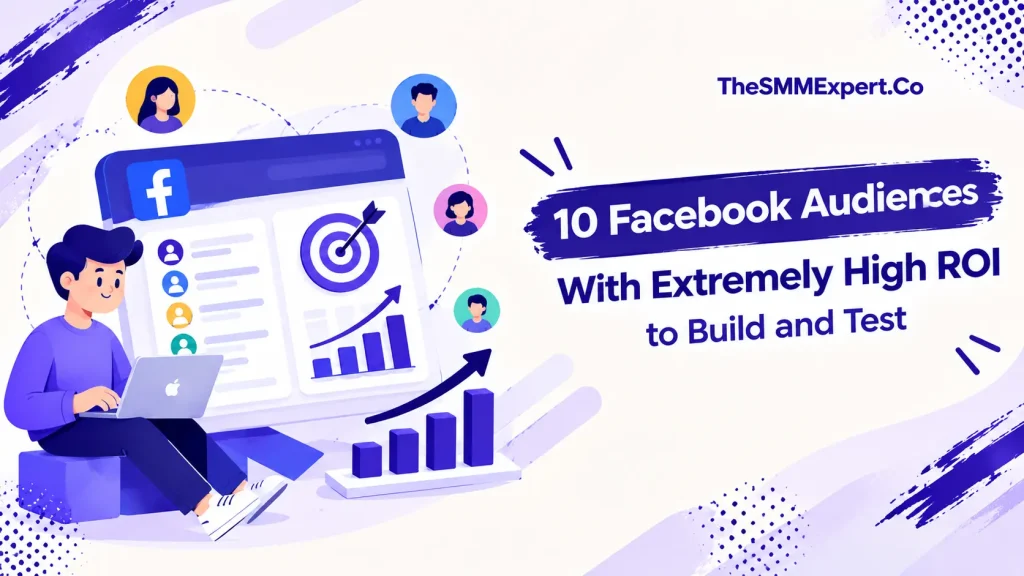
If you searched for 10 facebook audiences with extremely high roi, you likely want more than a list of targeting options—you want to know which audiences to build, when to use them, and how to avoid wasting budget.
Key Takeaways
- Start with high-intent visitors, abandoned carts, and existing customers before testing cold interests.
- Separate audiences by funnel stage so one ad doesn’t show the wrong message to every person.
- Build exclusions carefully to prevent audience overlap, wasted impressions, and confusing offers.
- Judge performance by profit, contribution margin, and customer value—not only low cost per click.
- Give each audience enough budget and time to produce a useful signal before making major changes.
The 10 High-ROI Facebook Audiences
The best Facebook audience depends on your sales cycle, purchase frequency, creative, and available traffic.
Use the table below as a prioritization guide. Audience quality means how strongly the people have demonstrated interest. Typical ROI is directional, not a guarantee; your offer and tracking determine the actual result.
| Audience | Funnel stage | Best use | Typical ROI potential |
|---|---|---|---|
| Existing customers | Retention | Repeat purchases, upgrades, referrals | Very high |
| Customer value segments | Retention or acquisition | Lookalikes based on profitable buyers | Very high |
| Recent website visitors | Consideration | Reminders, proof, limited offers | High |
| Product viewers | Consideration | Dynamic product retargeting | High |
| Add-to-cart users | Decision | Objection handling and urgency | Very high |
| Checkout starters | Decision | Recovery and reassurance | Very high |
| Lead-form openers | Decision | Follow-up and qualification | High |
| Video viewers | Awareness | Nurture warm prospects | Medium to high |
| Instagram engagers | Awareness or consideration | Social-proof and offer campaigns | Medium to high |
| Local offline prospects | Consideration or retention | Store visits, calls, appointments | High |
1. Existing Customers
Existing customers are often the first audience to test because they already know your brand promise and have completed at least one transaction. They may be ready for a replenishment, a complementary product, an upgrade, or a referral offer.
Create separate groups instead of placing every buyer into one list:
- Customers who purchased within 30 days
- Customers who purchased 31–180 days ago
- Customers who haven’t purchased for 180 or more days
- Customers who bought a specific product category
- Customers with two or more completed purchases
Match the message to the next action. A subscription company might promote renewal, while a clothing brand could show related products. A software company may advertise a higher plan, onboarding session, or team license.
Exclude recent buyers from acquisition campaigns when the ad promotes the same product they just purchased. Otherwise, you may pay to convince a person to buy something they already own. For consumables, estimate the normal repurchase interval and advertise shortly before that point.
2. High-Value Customer Segments
A list of all buyers is useful, but a list of your most profitable buyers is often more useful. Build a value-based audience from customers with strong total revenue, repeat purchases, long retention, or high contribution margin.
Possible source segments include:
- Customers above a defined lifetime-value threshold
- Subscribers who remain active after six or twelve months
- Buyers of premium packages
- Customers who purchase multiple product categories
- Accounts that generate recurring revenue
You can use this segment for retention messaging or as the source for a lookalike audience.
Your source data must be clean. Remove refunds, test orders, duplicate records, employees, and customers who opted out of applicable marketing. Meta’s Customer List Custom Audiences guidance explains the platform’s requirements for using customer information, including the need to handle data lawfully and responsibly.
Use profitability first. A customer who spends $500 but costs $450 to acquire may be less valuable than one who spends $150 repeatedly with low support costs.
3. Recent Website Visitors
Website visitors show interest, but not all visitors deserve identical treatment. Segment them by recency and depth of behavior:
- All visitors in the past seven days
- Visitors in the past 8–30 days
- Visitors who viewed two or more pages
- Visitors who reached a pricing or service page
- Visitors who spent time reading buying guidance
Recent visitors need a reminder, proof, or a next step.
Use a short retargeting window for fast decisions. Use a longer window for expensive purchases.
4. Product Viewers
Product viewers are more qualified than general website visitors because they examined a particular item or category. This audience is especially valuable for ecommerce businesses with enough catalog activity to support relevant creative.
Separate product viewers from people who added an item to their cart. Product viewers may still be researching, whereas cart users have shown stronger intent. Your ad should therefore address questions that prevent a first purchase:
- Shipping time and cost
- Warranty or return policy
- Product dimensions and compatibility
- Reviews and common use cases
- Comparison with an alternative model
Dynamic ads can show viewed or related products. They work best with accurate feeds. Mismatched or unavailable products can reduce trust.
5. Add-to-Cart Users
People who add an item to a cart have crossed an important behavioral threshold.
Build a cart recovery audience for common friction points. Useful creative can include:
- A concise explanation of shipping and returns
- Customer reviews or demonstrations
- A comparison chart
- Product guarantees
- A reminder of limited stock, only when accurate
- A small incentive with a clear expiration
Avoid automatically discounting every cart.
Use a one-to-seven-day window, then move older users to broader nurture. If your event tracking is delayed or incomplete, the exclusion may fail and make the campaign look less effective than it is.
6. Checkout Starters
Checkout starters have demonstrated even stronger intent than cart users. They may have entered payment details, shipping information, or another final-step event. This audience can justify a high-priority follow-up sequence.
The ad should focus on completion rather than broad education. Consider:
- “Finish your order” language
- Payment and security reassurance
- Delivery expectations
- Customer support availability
- A reminder of the selected product or service
- A direct link back to the correct checkout step
Don’t assume every checkout starter abandoned because of price. Review your checkout analytics alongside ad results.
7. Lead-Form Openers
Lead-form openers viewed or began a lead form but didn’t submit it. This is a useful audience for service businesses, education providers, insurance agencies, B2B companies, and local professionals.
The obstacle may be excessive form length, unclear value, privacy concerns, or a weak offer. Retarget with friction removal, not just “submit now” repetition:
- Explain what happens after submission
- State how quickly someone will respond
- Show the consultation agenda
- Reduce unnecessary questions
- Offer a useful guide, estimate, or checklist
- Use testimonials that address the prospect’s concern
Separate people who opened the form from people who submitted it. The first group needs completion messaging; the second may need appointment booking, qualification, or sales follow-up.
8. Video Viewers
Video viewers are valuable when the content communicates real product understanding, not merely a logo or short promotional clip. Build segments based on watch depth, such as people who watched 25%, 50%, or 75% of a video.
A person who watched most of a product demonstration is generally more qualified than someone who saw two seconds while scrolling. Use the audience to move prospects from awareness to consideration:
- Show a case-specific benefit
- Explain the next step
- Answer a common objection
- Invite a product comparison
- Direct viewers to a lead form or landing page
Keep the follow-up creative connected to the original video. If the first video demonstrates time savings, the next ad might show pricing or implementation.
9. Instagram Engagers
Instagram engagers include people who interacted with your profile, posts, reels, stories, or ads. They may not have visited your website, so this audience can capture warm interest that a website-only strategy misses.
Useful segments include:
- People who saved product posts
- People who sent direct messages
- People who watched reels
- People who commented on educational content
- People who visited the profile
- People who engaged within the last 30, 90, or 365 days
Use social proof and clarity rather than assuming engagement equals purchase intent.
10. Local Offline Prospects
For businesses with physical locations or phone-based sales, online behavior is only part of the buying journey. Build audiences around local prospects who interacted with your business through calls, appointment forms, directions requests, store visits, or offline customer records.
Examples include:
- People within a realistic travel radius
- Previous appointment no-shows
- Customers who visited once but didn’t return
- Leads who called but never booked
- Buyers eligible for maintenance or replenishment
- Event attendees who didn’t purchase
Local campaigns need operational alignment. Don’t advertise “same-day appointments” if your staff can’t answer calls or fulfill that promise. Use neighborhood-specific creative, accurate hours, parking information, service areas, and clear booking options.
Build Audiences Correctly
A strong audience can’t compensate for broken event tracking, weak exclusions, or vague campaign structure. Build the technical foundation before increasing spend.
| Setup step | What to configure | Common mistake |
|---|---|---|
| Install tracking | Browser and server-side events where appropriate | Counting page views as purchases |
| Define windows | Separate 1–7, 8–30, and 31–180 days | Mixing fresh and stale intent |
| Create exclusions | Purchasers, leads, employees, and irrelevant segments | Allowing audiences to overlap |
| Name consistently | Date, source, window, and purpose | Losing track of audience meaning |
| Check size and match | Review available volume and customer matching | Assuming every record is usable |
| Connect creative | One message for one audience stage | Showing generic ads to everyone |
Use names such as ATC_1-7D_NoPurchase_ProspectingExcl.
Warning: Don’t upload customer information casually or outside your legal and internal privacy requirements. Limit access, document consent or another lawful basis where required, and remove records not meant for advertising.
Verify that:
- Purchase events fire once per transaction
- Currency and value are passed correctly
- Cart and checkout events are distinct
- Lead submissions aren’t duplicated
- Purchasers leave the relevant prospecting group
- URLs preserve campaign parameters
- The ad’s landing page works on mobile devices
Match Message To Intent
Audience quality rises when the creative answers the question that the person is most likely asking at that stage.
| Audience stage | Prospect’s likely question | Creative angle | Primary action |
|---|---|---|---|
| Video viewer | “Why does this matter?” | Benefit, demonstration, problem education | Learn more |
| Website visitor | “Is this right for me?” | Proof, comparison, use case | View details |
| Product viewer | “Can I trust this choice?” | Reviews, specifications, warranty | Add to cart |
| Cart user | “Should I finish?” | Shipping, returns, reassurance | Complete purchase |
| Existing customer | “What should I buy next?” | Complement, upgrade, replenishment | Buy again |
| Lead-form opener | “What happens next?” | Process, response time, value | Submit form |
Use creative rotation when an audience sees the same message repeatedly.
Avoid making unsupported urgency claims. “Ends tonight” should mean something real, not an evergreen line that appears every week. Trust is an asset, especially for high-consideration products and local services.
Budget And Measurement
Allocate budget according to intent, audience size, and expected margin. A smaller audience also can’t spend indefinitely without rising frequency and declining response.
| Test type | Suggested duration | Change one variable | Success signal |
|---|---|---|---|
| Creative test | 7–14 days | Hook, image, video, or copy | Better qualified conversion rate |
| Audience test | 14–28 days | Retargeting group or source | Lower profitable CPA |
| Offer test | 14–28 days | Incentive or package | Higher contribution margin |
| Landing-page test | 14–28 days | Layout, proof, or form | More completed actions |
| Retention test | 30–60 days | Replenishment or cross-sell message | Higher repeat revenue |
The ranges above are planning guidelines, not guarantees.
Track more than platform-reported return on ad spend:
- Contribution margin after advertising cost
- Customer acquisition cost
- Revenue per visitor
- Qualified lead rate
- Appointment show rate
- Refund and cancellation rate
- Repeat purchase rate
- New-customer versus returning-customer revenue
Pro Tip: Maintain separate reporting for prospecting, retargeting, and retention. Blending them can make a campaign look exceptional simply because inexpensive retargeting conversions are mixed with more difficult new-customer acquisitions.
Troubleshoot Weak ROI
Poor results don’t always mean the audience is wrong. Diagnose the stage where performance breaks.
| Symptom | Likely cause | First correction |
|---|---|---|
| Many clicks, few purchases | Weak landing page or poor intent | Tighten message match and page offer |
| High frequency, falling results | Audience too small or stale | Shorten window or refresh creative |
| Low delivery | Audience too narrow | Broaden window or combine related groups |
| Cheap leads, few sales | Weak qualification | Improve form questions and follow-up |
| Retargeting looks perfect | Overlap or attribution inflation | Add exclusions and compare blended results |
| Sales event count is wrong | Tracking or deduplication error | Audit event setup and order IDs |
| Strong CTR, low margin | Discounting or low-value buyers | Optimize toward profit and customer value |
Start with the data flow. If purchases are missing, duplicated, or assigned the wrong value, changing copy won’t solve the core problem.
Check frequency, comments, creative fatigue, landing-page speed, mobile usability, offer clarity, and follow-up speed. For lead generation, a five-minute response can produce a very different result from a next-day response, even when the ad is unchanged.
Conclusion
Choose one high-intent audience—usually recent cart users, qualified leads, or existing customers—and audit its tracking, exclusions, creative, and profit for the next seven days. Once that foundation is reliable, expand into value-based lookalikes and broader prospecting instead of launching all ten audiences at once.
Frequently Asked Questions
What is the highest-ROI Facebook audience?
There’s no universal winner, but recent checkout starters, cart users, and existing customers often have the strongest intent. Test them separately, exclude completed purchasers, and compare profit rather than return on ad spend alone.
How large should a retargeting audience be?
Use the largest practical window that preserves useful intent. A seven-day audience may be ideal for fast purchases, while professional services may need 30–180 days. If frequency rises quickly, shorten the window or refresh the creative.
Should I target interests or retarget visitors first?
Retargeting usually deserves the first test when you have enough qualified traffic. Interests are useful for reaching new prospects, but they require stronger creative, broader testing, and more patience because the audience hasn’t yet demonstrated direct intent.
Why is my Facebook retargeting campaign not spending?
The audience may be too small, exclusions may remove most eligible people, the window may be too short, or the campaign may have a restrictive bid or optimization event. Check estimated size, event volume, delivery settings, and audience overlap.
How often should I refresh Facebook ads?
Refresh when frequency rises and qualified conversions decline, not simply because a calendar date passed. Many businesses can test a new hook, image, or video every few weeks, but the correct rhythm depends on audience size and spend.
Are lookalike audiences still useful?
They can be useful when the source contains enough high-quality, recent customers or qualified leads. A value-based buyer source is generally more informative than an unfiltered list of page visitors or low-intent clicks.
 Written byMatthew WilliamsMatthew Williams is a digital marketing writer and social media expert with over 8 years of experience. He works with Facebook, Gmail, and online reputation problems. He writes clear, useful content to help people, creators, and businesses fix Facebook problems, keep their pages safe, and use Meta’s tools more effectively. His work talks about Facebook Ads, Business Manager, keeping your pages safe, growing your audience.