On this page
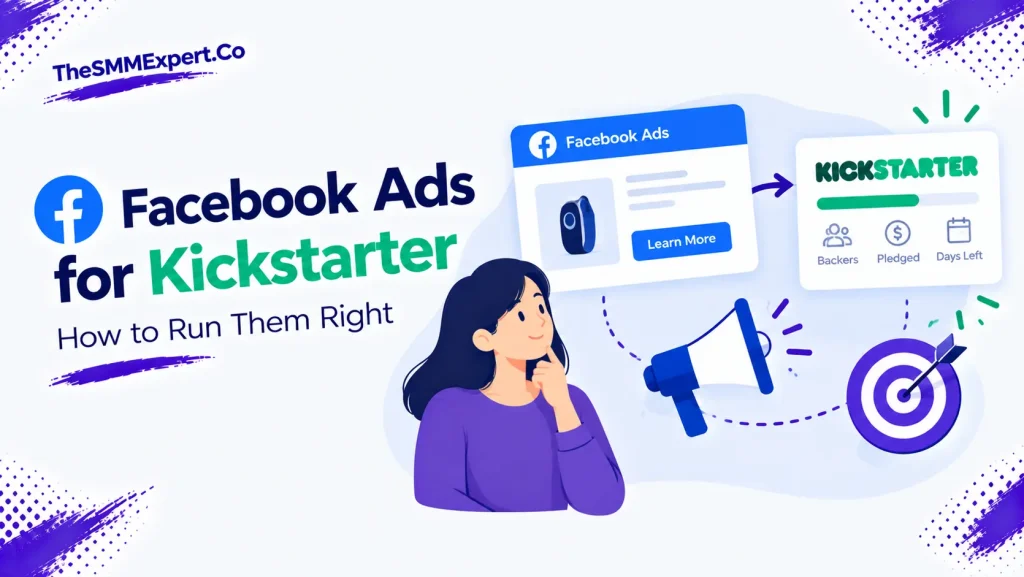
Facebook ads for Kickstarter can help a campaign reach people beyond its existing audience, but they work best as part of a measured launch system—not as a substitute for a strong product, clear page, or credible audience. The practical goal is to turn attention into email signups, page visits, and pledges while learning which message and audience deserve more budget.
Key Takeaways

- Build a tracking system before spending: use a Meta Pixel and UTM-tagged links so traffic and conversions are distinguishable.
- Start with creative testing, not aggressive scaling. Test several hooks, images, videos, and audience angles with a controlled budget.
- Send cold visitors to a pre-launch signup page before launch whenever possible; direct pledge campaigns require more trust and stronger proof.
- Judge ads by profitability and pledge quality, not clicks alone. A cheap click that never pledges isn’t a successful result.
- Retarget people who watched videos, visited the campaign, or joined your list, but exclude existing backers when asking for a first pledge.
- Keep a reserve for the mid-campaign dip, when new creative and retargeting can matter more than simply raising daily spend.
Facebook Ads for Kickstarter Strategy
Kickstarter campaigns usually need three advertising phases: audience building before launch, conversion during launch, and retargeting throughout the campaign. Each phase has a different objective, audience, landing page, and success metric.
- An ad introduces the product or problem.
- The prospect visits a landing page or Kickstarter page.
- The prospect joins an email list, watches more content, follows the campaign, or pledges.
- Follow-up ads answer objections and reinforce urgency.
- Existing backers receive updates rather than repeated acquisition ads.
Pre-launch versus live campaign
Pre-launch advertising is easier to optimize because email signup is simpler than a pledge.
| Phase | Main objective | Best destination | Primary metric |
|---|---|---|---|
| Four to eight weeks before launch | Find interested prospects | Email signup page | Cost per qualified subscriber |
| Launch week | Capture high intent | Kickstarter campaign page | Cost per pledge |
| Middle of campaign | Recover undecided visitors | Kickstarter page or comparison page | Return on ad spend |
| Final days | Convert warm audiences | Kickstarter page | Incremental pledges |
Audience quality matters more than raw volume. Ten thousand people who match the product category and can afford it are more useful than a much larger group gathered through a vague giveaway.
Before advertising, define your campaign’s economics. Include the reward price, expected average pledge, manufacturing and fulfillment costs, platform and payment fees, taxes where relevant, agency or creative costs, and your acceptable acquisition cost.
For example, if a reward averages $90 but the contribution left after product, fulfillment, and fees is $34, acquiring that backer for $50 loses money even though the ad appears to generate a $90 sale.
Set Goals and Tracking
Choose one primary conversion event for each phase. A pre-launch campaign might optimize for completed email registrations. A live campaign might optimize for a tracked pledge if the checkout and attribution setup can reliably report it.
Set up these elements:
- Meta Business Manager and an advertising account
- Meta Pixel on your landing page
- Server-side or first-party event tracking where technically appropriate
- UTM parameters for every ad variation
- A dashboard combining ad spend, sessions, signups, pledges, refunds, and revenue
- A consistent naming convention for campaigns, ad sets, ads, and creative versions
A naming system prevents confusion when you have dozens of variations. For example:
PRELAUNCH_US_PROBLEM_VIDEO_01
LIVE_RETARGET_30D_PAGEVISITORS_STATIC_03
UTM structure:
utm_source=facebook
utm_medium=paid_social
utm_campaign=launch_week
utm_content=hook_a_video_02
Track the full funnel
Don’t stop at link clicks. Record each meaningful stage:
| Funnel stage | Event or measurement | What it tells you |
|---|---|---|
| Impression | Reach, frequency, CPM | Whether delivery is affordable |
| Click | Link CTR, CPC, landing-page views | Whether the ad earns attention |
| Interest | Video completion, signup rate | Whether the message fits the audience |
| Intent | Campaign-page views, reward clicks | Whether visitors are evaluating the offer |
| Outcome | Pledges, revenue, CPA, ROAS | Whether advertising supports the goal |
Attribution limits are unavoidable.
Use a simple reconciliation sheet. Compare ad-attributed pledges, total daily pledges, email-driven pledges, and direct traffic.
Build Your Audience

Audience research should begin with the product, not with random interests inside Ads Manager. Write down who has the problem, who already buys alternatives, and who is likely to explain or recommend the product to others.
Useful audience inputs include:
- Existing customers and newsletter subscribers
- Kickstarter followers and previous backers
- Product waitlists and survey respondents
- Competitor categories, adjacent hobbies, and use cases
- Search terms from customer interviews
- Video viewers and campaign-page visitors
- Creator, community, and publication partnerships
Use first-party data carefully
Upload customer or subscriber lists only when you have the appropriate permission and a lawful basis to use them for advertising. Hashing doesn’t turn an improperly collected list into a permissible one.
Create separate audiences for:
- Existing customers
- Email subscribers who haven’t pledged
- Website visitors in the last 30 days
- People who viewed at least 25% or 50% of a product video
- Kickstarter visitors, where your tracking setup supports that distinction
- Existing backers, for exclusion or update messaging
Cold targeting can include broad audiences, lookalikes, and relevant interests. Avoid stacking so many interests that delivery becomes tiny and expensive.
Use exclusions. Exclude backers, recent converters, and people who completed the next action.
| Audience | Message angle | Creative | Landing destination |
|---|---|---|---|
| Broad adults in target countries | New solution | Demonstration video | Signup page |
| Category interest group | Better than common alternative | Comparison image | Signup page |
| Existing subscribers | Launch announcement | Founder or product video | Kickstarter page |
| Video viewers | Proof and objections | Testimonial or FAQ video | Kickstarter page |
| Page visitors | Reward and deadline | Static reminder | Kickstarter page |
Don’t assume every country is equally viable. Shipping costs, restrictions, language, currency, and pledge behavior can change the economics.
Create Campaign Assets
Your creative must answer the viewer’s first questions quickly: What is this? Who is it for? Why should I care now?
Prepare these formats:
- Short vertical videos for mobile placements
- Square product images for feeds
- Demonstration clips showing the product in use
- Founder-led explanations
- Before-and-after or problem-solution sequences
- Carousel cards explaining features or reward tiers
- Static ads focused on launch timing or limited bonuses
Build multiple hooks
The first sentence or visual should identify a problem, desire, or surprising use case. Examples:
- “A travel mug that fits under airplane seats”
- “The compact tool built for small kitchens”
- “Stop carrying three chargers for one trip”
- “A cooperative game for players who dislike elimination”
- “Designed for people who need quieter desk gear”
The hook must be accurate. Avoid implying endorsements, performance claims, delivery certainty, or scarcity that the campaign can’t support.
A creative brief includes:
- Target audience
- Pain point or desired outcome
- One central promise
- Demonstration or evidence
- Reward or next step
- Disclosure of material relationships when relevant
Creative volume shouldn’t mean meaningless variations. Change one factor at a time: hook, angle, proof, format, or call to action.
Disclose financial relationships with the project in the content and caption.
Make the landing page match
A cold visitor should see the same promise on the ad and landing page.
Include:
- Product explanation above the fold
- Clear product photos or video
- Price or expected reward level
- Estimated delivery timing
- Shipping regions and costs
- Founder or company identity
- Risks and uncertainties presented honestly
- Email signup or pledge button
- Frequently asked questions
A beautiful ad can’t repair a confusing campaign page.
Choose Campaign Structure
Keep the initial account structure simple enough to learn from.
A reasonable starting structure is:
- One prospecting campaign for cold audiences
- One retargeting campaign for warm visitors and viewers
- One existing-subscriber campaign if your list is substantial
- Three to six ads per important audience group
Match objectives to actions. Inexpensive traffic may not suit signups or pledges.
Testing versus scaling
Testing asks, “Which message and audience deserve more investment?” Scaling asks, “How can I spend more without damaging efficiency?”
| Situation | Recommended action | Avoid |
|---|---|---|
| No impressions | Check approval, audience size, bid, and budget | Assuming the creative failed |
| Impressions but few clicks | Test hook, image, or promise | Raising budget immediately |
| Clicks but no signups | Fix page speed, message match, or form | Blaming the audience first |
| Signups but no pledges | Improve trust, offer, or follow-up | Optimizing only for cheap leads |
| Strong results for several days | Increase carefully or duplicate strategically | Making many changes at once |
Controlled changes preserve learning.
Budget and Bidding
Your budget should follow the amount of valid learning you need and the value of a backer—not an arbitrary daily number.
Start by estimating:
- Desired number of qualified leads or pledges
- Acceptable cost per result
- Testing period
- Number of creative and audience combinations
- Cash available for unsuccessful tests
- Reserve for launch and final-day activity
A simple planning model is:
planned spend = target results × acceptable cost per result
Small campaigns may test $30 to $150 daily per audience group.
Know your break-even point
Use contribution margin rather than top-line pledge value:
break-even CPA = average pledge − product cost − fulfillment − fees − variable support costs
Budget increases should be gradual when performance is stable. If results worsen, pause the increase and compare creative fatigue, frequency, audience overlap, and landing-page conversion.
Launch and Optimize

Launch with enough variation to learn, but not so much that every ad receives too few impressions.
Review performance daily for major problems and make deeper decisions on a consistent schedule.
A practical schedule
| Time | Review | Decision |
|---|---|---|
| First 24 hours | Approval, delivery, broken links, comments | Fix technical issues |
| Days 2–3 | CTR, CPC, landing-page views, frequency | Remove obvious weak ads |
| Days 4–7 | Signup or pledge conversion | Reallocate toward credible winners |
| Week 2 | Fatigue, audience overlap, new objections | Refresh creative |
| Final week | Retargeting, deadline clarity, inventory or reward limits | Protect trust while increasing urgency |
Don’t pause an ad solely because one day is weak. Compare several days and account for weekday effects, email sends, campaign updates, and major external events.
Comment management is part of conversion optimization. A recurring question belongs in the ad, landing page, or FAQ.
Be cautious with urgency. Artificial countdowns can damage trust and create compliance concerns.
What Should You Measure?
The right metric depends on the funnel stage.
Track these metrics together:
- CPM: cost to deliver impressions
- Link CTR: percentage of impressions producing link clicks
- CPC: cost per link click
- Landing-page view rate: whether clicks become page loads
- Signup conversion rate: signups divided by relevant visitors
- Cost per signup
- Pledge conversion rate
- Cost per pledge
- Average pledge value
- Revenue and contribution margin
- Frequency and creative fatigue
- Refunds, failed payments, and cancellations
Use the formulas consistently:
CTR = link clicks ÷ impressions × 100
signup rate = signups ÷ landing-page visitors × 100
cost per signup = ad spend ÷ signups
ROAS = attributed revenue ÷ ad spend
ROAS context matters. A 2.0 return may be excellent for one reward and unprofitable for another. Compare periods, hold out a small audience where practical, and look for changes in total campaign performance.
Interpret metrics as a sequence:
- Low CTR usually points to a weak hook, mismatched audience, or uninteresting visual.
- Strong CTR with low signup rate usually points to a page, offer, trust, or message-match problem.
- Strong signups with low pledges usually points to follow-up, product-market fit, reward value, or campaign credibility.
- Rising frequency with falling CTR often indicates creative fatigue.
- Good platform ROAS with flat total pledges may indicate cannibalization rather than growth.
Retargeting and Scaling
Retargeting should give people a reason to return, not merely repeat the original ad.
Useful windows include:
- Video viewers in the last 7 days
- Landing-page visitors in the last 14 days
- Campaign-page visitors in the last 30 days
- Email subscribers who haven’t pledged
- Cart or reward interactions, if available
- Existing backers for referral or update messaging
Match the message to the objection:
- Visitors who didn’t understand the product need a demonstration.
- Visitors who compared rewards need a simple tier explanation.
- Email subscribers who delayed need launch timing or a relevant update.
- Video viewers who didn’t click may need proof, reviews, or shipping information.
Scale in layers
Scale the strongest audience, creative, and landing experience.
Consider these scaling methods:
- Increase budget gradually on a stable campaign
- Add a broader audience while retaining exclusions
- Expand to a country only after confirming shipping economics
- Create new creative using the winning message
- Retarget warm visitors with proof and FAQs
- Use email and organic updates to support paid traffic
Scaling warning: More impressions don’t always mean more incremental backers.
A campaign also needs a stop rule. Pause a test when it spends a set amount without signal, the page has a technical problem, or the audience is irrelevant.
Common Problems
Ads approved but barely delivered
Check the scheduled start time, payment method, account restrictions, audience size, bid controls, and placement availability.
Cheap clicks, no pledges
This usually indicates a mismatch between the ad promise and the campaign page, weak trust, poor mobile usability, an unclear reward, or an audience attracted by curiosity rather than need.
Results collapse after launch
Look for creative fatigue, negative comments, a broken tracking event, an email list that already converted, shipping concerns, or a reward that became unavailable.
Tracking doesn’t match Kickstarter
Attribution windows, privacy settings, device changes, link redirects, and delayed pledges can all create differences. Never “fix” the numbers by counting every pledge as ad-driven.
Comments damage trust
Respond with factual information, publish updates when the answer affects everyone, and avoid arguing with skeptical users.
Frequently Asked Questions
Should I advertise before Kickstarter launches?
Usually, yes, if you have time to build an interested audience. Pre-launch ads can collect email subscribers and reveal which message attracts qualified prospects.
How much should I spend on Facebook ads?
Use a range based on your acceptable acquisition cost and learning needs rather than a universal budget. A small test may use roughly $30 to $150 per day across carefully chosen ad groups, while a larger campaign should model spend against contribution margin and target pledge volume.
Should ads go to Kickstarter or a landing page?
Send cold traffic to a landing page when you need to explain the product, collect permission-based email leads, or segment interest. Send high-intent visitors directly to Kickstarter when the campaign page already answers product, price, shipping, trust, and delivery questions clearly.
What objective should I choose?
Choose the objective that corresponds to the measurable action you want. Use lead-focused optimization for qualified pre-launch registrations and conversion-focused optimization for tracked pledges where reliable purchase signals exist. A traffic objective isn’t a substitute for conversion tracking.
How long should I test an ad?
Test until you have enough spend and conversion data to make a decision. Review delivery and technical issues immediately, then compare several days while accounting for audience size, budget, seasonality, and the length of the pledge decision.
Conclusion
Starting with one well-tracked audience, several genuinely different creatives, and a realistic break-even CPA is safer than launching a complicated account. Build the pre-launch list if possible, document every change, and judge success by incremental profitable pledges rather than attractive dashboard metrics alone.
 Written byMatthew WilliamsMatthew Williams is a digital marketing writer and social media expert with over 8 years of experience. He works with Facebook, Gmail, and online reputation problems. He writes clear, useful content to help people, creators, and businesses fix Facebook problems, keep their pages safe, and use Meta’s tools more effectively. His work talks about Facebook Ads, Business Manager, keeping your pages safe, growing your audience.