
A social media marketing strategy is a well-planned design to define your target audience, your content structure, the right platform to use, and to measure whether it is working or not. That means it connects every piece of content to a purpose instead of impulse posting, hoping that something works.
Unfortunately, most strategies fail since they are not strategies at all. They are basically posting schedules wearing a strategy costume. This guide will fix the problem and show you a step-by-step framework to create the strategies, how to apply them, how to choose the right platform, and what to post.
What a social media marketing strategy actually is (and what it isn’t)
A social media marketing strategy answers three questions.
- Who are you for?
- What are you saying?
- How will you know it is working?
Everything else, such as calendar, hashtags, or posting times, is the execution of those three answers. Once you know these questions and answers, you can separate these three words people use interchangeably.
- Strategy defines your audience, goals, content themes, and platforms.
- Plan defines the operations such as specific posts, campaigns, and cadence.
- Calendar is the schedule of that content that answers what, where, and when.
You need these three things to succeed in social media marketing. The test of a good strategy is simple. When a post underperforms, does your strategy tell you what went wrong? If yes, you have a solid strategy.
Why most social media efforts fail (the honest diagnosis)
Before the framework, you need to know why effort often produces nothing. Almost every effort fails due to one of these 5 reasons.
- Posting without a goal: If you fail to understand what a post is for – a click, awareness, a sale, or a reply – you cannot tell whether it is successful or not. You cannot even improve it. Effort needs direction to be productive.
- Wrong platform for the audience: Being active on the wrong platform that your audience does not use is invisible work. A B2B service posting on TikTok makes no sense.
- No consistent voice: When visitors land on your profile, they decide whether to follow or not in seconds. A feed with versatile tones and topics gives them no reason to follow. A consistent voice is what turns an interested visitor into a follower.
- Broadcasting instead of conversing: Social media platforms reward engagement, not announcements. Brands that push promotional content without regular replies, asking, and engaging get throttled by the algorithm.
- Quitting before the 90-day mark: You need three months to get the real signal. People who work really hard for a few weeks and give up based on bad performance cannot get success. Impatience kills more accounts than bad content.
Notice that four out of these five reasons have no relation to content quality. You can make quality content and still fail on strategy. That’s the gap we will close in this guide.
The 7-step framework (overview)
Everything fits into these 7 steps, and each one builds on the last. So check and follow every step.
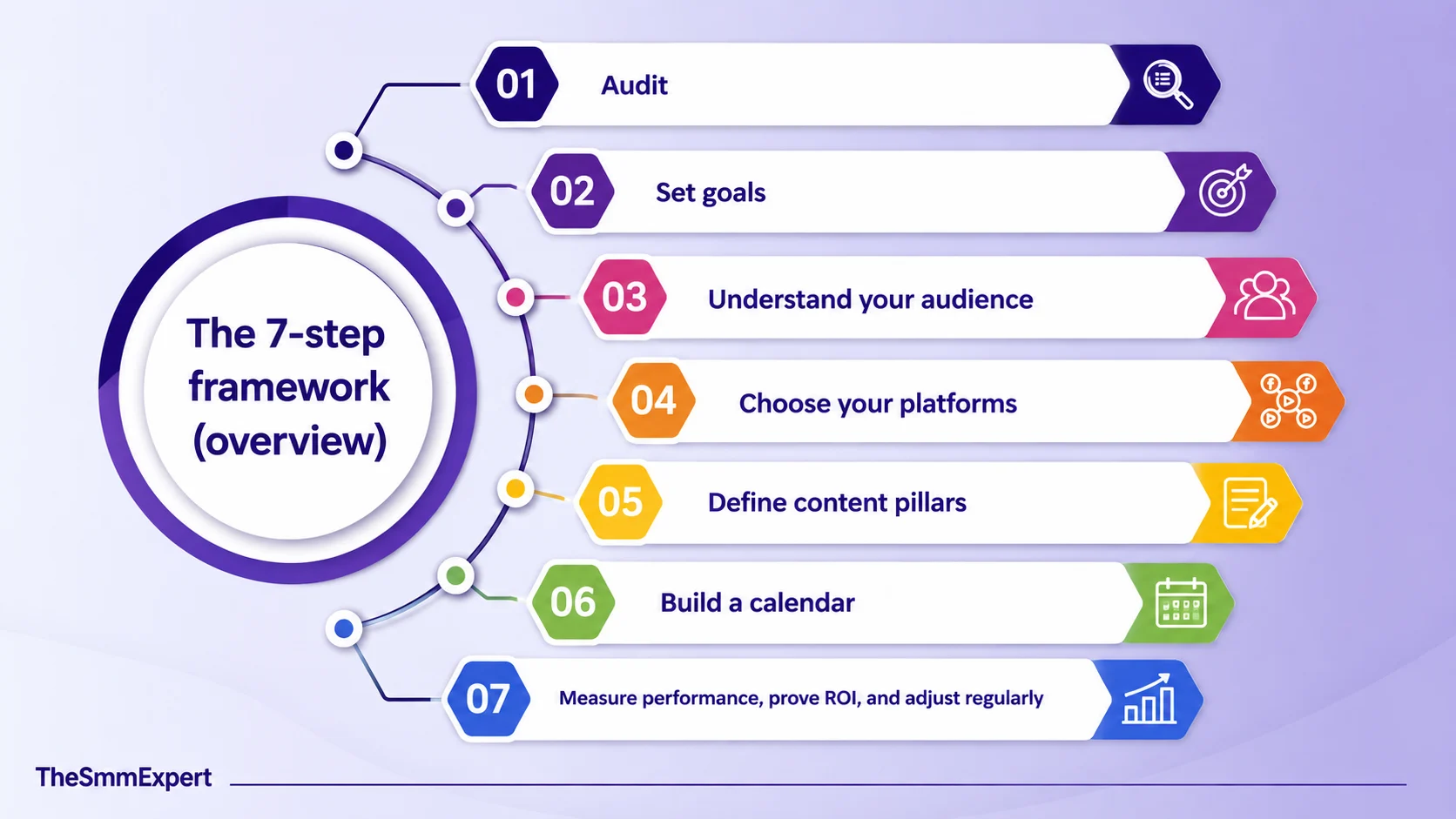
- Audit your existing content and strategy.
- Set goals aligned with the business outcomes.
- Understand your audience based on your target, even with zero data.
- Choose your platforms according to your needs, not by default.
- Define content pillars to solve the “what do I post” problem.
- Build a calendar that you can maintain.
- Measure performance, prove ROI, and adjust regularly.
Step 1: Audit what you already have
Understanding the current state is the first step of a successful strategy. You cannot plan forward if you don’t know where you stand. Follow this checklist to audit your account.
List every account you have, including the most inactive ones. That abandoned profile still represents you.
Find your best and worst posts: Check all the content from the last 90 days and find the best and worst content based on the likes, shares, saves, and comments.
Run the incognito test: Open the profile in an incognito tab to check the bio, pinned post, and last three posts. Does a visitor landing on your profile for the first time understand what you do in five seconds?
Check the platform’s lifecycle stage – Check profiles on all the platforms and see which one is genuinely growing and where you are less present. That single distinction will tell you where to push and where not to.
Check competitors: Follow the same audit for your top 5-10 competitors. Understand their platform mix, top content, posting frequency, and themes to identify the difference between a successful profile and your one. The gap is your opening.
Step 2: Set goals that actually mean something
A goal becomes useful when you can measure it. ‘I will grow my Instagram profile’ is a wish. ‘I will reach 50,000 non-followers per month and convert 5000 into followers by Q3’ is a goal you can measure and act on.
Try SMART framing – Specific, Measurable, Achievable, Relevant, and Time-bound. Convert each goal into a KPI to understand the progress.
| Vague goal | SMART goal | KPI to track |
|---|---|---|
| Get more followers | Grow to 5,000 followers by Nov 30. | Follower growth rate. |
| Boost engagement | Improve average engagement rate by 4% within the next 3 months. | Engagement rate per post |
| Drive sales | Get 200 link clicks/month from bio. | Clicks + conversions |
| Build authority | Publish 10 quality posts/month with an average of 5k impressions. | Impressions per post |
Don’t set unrealistic goals since failing to achieve them will demotivate you and keep you away from following the strategies. Understand the metrics properly to match each goal. Awareness goals live on impressions and reach, growth goals live on follower count, conversion goals live on clicks, sales, and sign-ups, and care goals live on response time.
Try not to mix up all the goals and work on one goal per quarter, per platform. Chasing awareness and sales goals on the same channel at the same time does not work well.
Step 3: Understand your audience (even with zero data)
“Understand your audience” seems cliché, but this is the least explained advice in the marketing sector. Let’s see how you actually do it.
If you already have data about your customers, mine it properly. Understand the demographics, interests, and problems from your analytics, DMs, reviews, and comments. Pay attention to every detail and what they care about the most. Understanding what your audience says in their own words is the right language to use in your content.
If you don’t have data yet, you can still understand the audience. Imagine this: in your business, who are the people you would be most thrilled to help, and what problems they are facing.
Get an idea and sharpen it through the following.
- Check competitor comment sections since your audience is already there sharing their problems for free.
- Sit in communities like Discord servers, subreddits, and Facebook groups where your customers and competitors gather.
- Cross-reference public data from Pew Research and DataReportal to understand which platform is better for your audience.
Create a data table for the audience with their age range, platform they live on, problems they are facing, and questions they are asking or have already asked. Create another data table for the competitors about the problems they are solving, the tone they are using in the content, the posting time, and others. It will give you a clear picture of your audience. But remember the actual data will start coming once you start posting.
Step 4: Choose your platforms (stop trying to be everywhere)
Being active on every platform is the fastest way to burnout and mediocre results. You don’t need to be everywhere, especially on those platforms where your audience’s presence is zero. Ask yourself these four questions to decide.
- Where is your audience in a buying mindset? Your audience might be present on social media but still be in a non-purchasing mindset. Being there to generate sales is a wrong idea. People scroll TikTok to be entertained and search LinkedIn to make business decisions. Some people use Facebook for fun and purchase at the same time. Match the platform intent, not just presence.
- What format can you realistically produce every day? Understand your capability to determine the right platform. If you cannot produce short-form attractive videos, TikTok, Instagram, and YouTube will punish you. Play what you can actually make.
- What does the algorithm reward? Different platforms optimize for different behavior. Some prioritize watch time, some reward dwell time, meaningful replies, and others. So understand what the algorithm rewards and act on that. Check the table below.
- Does the platform’s culture fit your brand? Understanding the vibe on the platform matters. For example, LinkedIn is better for professionals, but warming up; Instagram is good for aspirational and polished content.
Use this cheat sheet for help.
| Platform | Best for | Rewards | Content that fits |
|---|---|---|---|
| Visual brands, lifestyle, B2C. | Saves & shares | Strong visuals, Reels, carousels. | |
| TikTok | Discovery, younger audience. | Watch time, completion. | Hooks, short videos, trends. |
| B2B, Jobs. | Dwell time, comments. | Insights, carousels, text posts. | |
| YouTube | Depth, evergreen search. | Watch time, CTR, comments. | Long video, shorts, tutorials. |
| Wider reach, community, local. | Engagement and interactions. | Posts, groups, videos. | |
| X (Twitter) | Real-time, conversation. | Replies, reposts. | Text, timely takes, threads. |
| Search, lifestyle, ecommerce. | Saves, click-through | Vertical images, how-tos. | |
| Threads | Conversational reach | Replies, shares | Text, casual updates |
Start with one or two platforms and perform well. Once you have an established channel, you can add more platforms. You can utilize the same content on multiple platforms. For example, a quality short can be used on TikTok, YouTube, Facebook, and Instagram.
[Follow these guides to grow your followers.
- Instagram Growth
- TikTok Growth & Going Viral
- Growing a YouTube Channel
- Facebook for Business, Ads & Accounts
- Online Reviews & Reputation Management
- Growing on X (Twitter)
- LinkedIn for B2B Growth & Social Selling
- The Complete Guide to grow Threads
- The Complete Guide to SoundCloud marketing
Step 5: Content pillars and the “I don’t know what to post” fix
Inventing new content and publishing regularly is the biggest challenge for social media marketing. Understanding the strategy and implementing it is different, especially the content part.
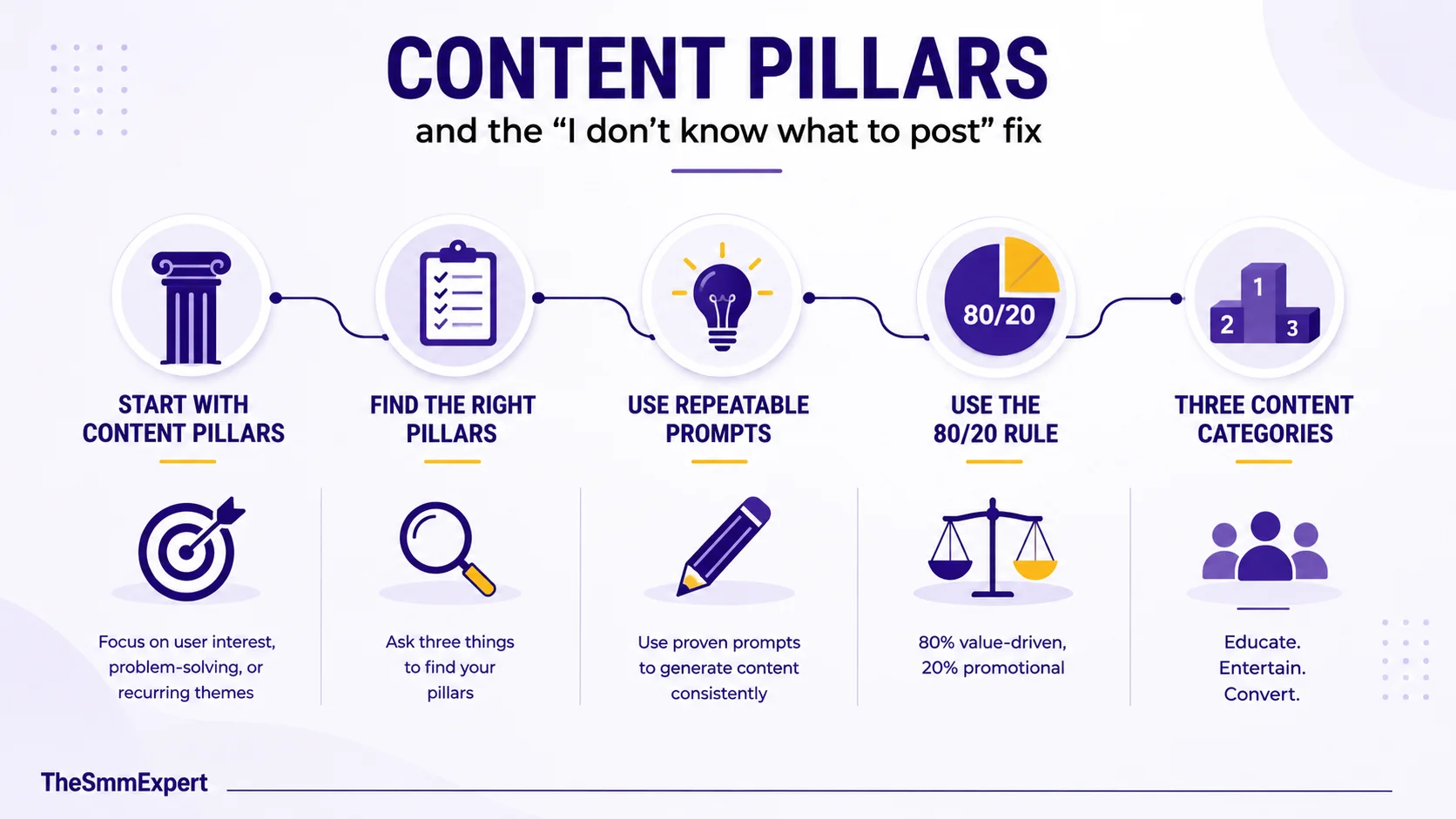
Start with content pillars focusing on user interest, problem-solving, or recurring themes of your business. Pillar posts keep you from reinventing new content every day and make your feed feel connected. A new visitor can instantly understand your niche and know what to expect.
For example, a career coach might use salary negotiation, industry news, interview tips, and workplace stories. When they show up on your feed, you can instantly understand what you are getting.
But the question comes how to find the right pillar? Ask three things to find your pillars.
- What does your audience search for?
- What do you have a credible take on?
- What is not already saturated?
Once you have answers to these questions, you will get the pillars. Then use these repeatable prompts:
- The podcast test: If you were invited on an audio podcast and needed to talk about your niche, what would you talk about? Every answer is a pillar, and each sub-point is a post.
- Mine your own comments and DMs: Check your comment section or DMs and see the questions you asked. Every question or problem is a new post.
- Turn one idea into a week: Diversify the content and turn one idea into a video, text post, story, and carousel to upload on different platforms.
- Answer the searches: Find out what your audience searches for and answer those exact questions in their words.
Use the 80/20 rule so you are not constantly selling. Regular promotional content makes the audience bored. 80% of content should be educational, informative, or entertaining, and 20% of the content should be direct promotions.
Divide your content into three categories.
- Education or informational, like how-to, tips, and others.
- Entertainment, like behind-the-scenes, trends, and relatable moments.
- Conversions, such as offers, results, and products.
Step 6: Build a calendar you can actually maintain
The reason most strategies fail after a few weeks is not laziness; it is an unrealistic schedule. A realistic content calendar can help you overcome this problem and turn your strategy into a workflow that you can follow.
Remember that a single post a week for any platform is a legitimate starting point. Starting aggressively can burn you out, and starting slowly may seem inactive. So balance the posting cadence.
| Platform | Sustainable cadence (2026) |
|---|---|
| Daily | |
| 5-7 posts/week | |
| TikTok | Daily |
| X (Twitter) | 2-4 posts/day |
| 1-3/week | |
| YouTube | 1 video/week + 1–3 shorts |
Maintain three habits to be consistent in the field.
- Create in batches: Produce your content in a batch to cover weekly or monthly demand. It keeps the momentum and theme aligned.
- Repurpose: Try to use a core idea to feed every platform. Make a long YouTube video, upload it to Facebook, make shorts from the single video, and upload them to Instagram, TikTok, Facebook, and YouTube. You can use AI to create shorts, infographics, text posts, etc.
- Set a minimum viable schedule: Be consistent and set a target that you can hit even in your bad week. Consistency at a low volume beats bursts followed by discontinuation.
Step 7: Measure, prove ROI, and refine
This is the step that shows your progress and helps you improve without guessing. Let’s look at the math to understand metrics.
- Engagement rate = (likes + comments + shares) ÷ followers × 100. This shows your content performance. A 3- 4% rate is healthy for most platforms.
- Click-through rate (CTR) = (clicks ÷ impressions) × 100. It shows you whether your call-to-action or thumbnail works or not.
- Conversion rate = (conversions ÷ clicks) × 100. Shows you whether the traffic or TG is right or you are producing content for the wrong people.
- Follower growth rate = (net new followers ÷ starting followers) × 100. Shows your expansion.
- ROAS (for paid) = revenue ÷ ad spend. Shows you whether your spending is working or not.
Then separate vanity metrics from business metrics since follower count and raw likes do not signal value. You need more saves, comments, shares, clicks, and conversions for your business. Track those to map your goal.
Set a review rhythm: analyze monthly, pivot quarterly since weekly data is too noisy to make a decision. Analyze monthly to understand the growth and set new strategies. Check quarterly to find out underperforming pillars and platforms.
If you see less growth, you should consult a social media specialist like TheSmmExpert to find out your underlying issues and solve them.
Social media strategy in 2026: AI, social search, and what changed
The seven-step strategy is evergreen, but the landscape around it has changed, and you need to adapt to these changes. Understand the following to create your strategies and stay ahead of your competitors.
Social platforms are now search engines: A large number of people are now using TikTok and Instagram to search for products before opening Google. It means your content, profiles, and captions need real keywords to rank properly. Social SEO becomes mandatory, and optimizing the content for discovery in search affects performance and growth.
AI belongs in the workflow, not the voice: Use AI to brainstorm angles, repurpose one piece of content across different platforms, and create caption variations. However, provide a human touch to outperform AI-generated content on every platform. Audiences can easily detect AI content and human content.
Stop sending people off-platform too early: All the platforms suppress content that pushes their audience away. So build a relationship first so that the audience stays on your content and asks for a click later.
Optimize to be cited by AI answer engines: More and more people are using AI to ask questions instead of searching. Optimize the content with proper depth and consistency to get cited. Clear, well-structured, and authoritative content increases the chance of getting cited.
Playbooks by business type- Which platform to choose?
Follow these playbooks to choose your platform.
B2B: LinkedIn is the anchor here. Focus on thought leadership, employee voices, and insight over polished brand content. Lead quality matters here more than follower count.
B2C/ecommerce: Fast, visual, and frequent posts are needed, and Instagram, TikTok, Facebook, and Pinterest carry the most weight here. Short-form video drives more discovery, and user-generated content and social proof drive sales.
Creators: Choose any platform you enjoy and feel comfortable with. Outlast your competitors through consistency, quality, and interest.
Local business: Facebook is the leader here. Community engagement and local groups drive more foot traffic than viral reach. A well-managed Facebook page or group tied to a real customer relationship is worth more than a huge but distant following. You can also try Google My Business to get better results.
Common social media marketing mistakes to avoid
Many businesses fail due to some common errors. Watch for these while doing social media marketing.
- Over-promoting: Don’t make every post a sales pitch that people tune out. Maintain an 80/20 ratio for balance.
- Ignoring comments and messages: Not replying to comments and messages indicates that you do not care about the audience, leading to less engagement. You prevent the algorithm from rewarding you. Respond to every comment and message as soon as possible.
- Chasing vanity metrics: A higher follower count without proper engagement or conversions is a hollow number. Never go for such vanity metrics. Optimize for the metric to get sales, leads, and engagement.
- Jumping on every trend off-brand: Maintain relevancy and never go for reach at the cost of relevance. A trend that does not fit your voice does more harm than good. Your audience gets diluted, and your brand then gets scattered.
- Inconsistency: This is the largest silent killer for marketing. Sporadic posting resets the momentum and changes the steadiness.
- Spreading too thin: Don’t go after every platform. Target one and be good at that. One well-optimized, consistent platform is better than five neglected platforms.
Key takeaways
- A real strategy will answer who you are for, what you are saying, and how to measure performance. Everything else is exclusion.
- Most marketing fails due to unrealistic goals, inconsistency, wrong platforms, and quitting too early. Bad content is not the reason for failure since you can improve the content quality slowly.
- Work in order: audit, set goals, understand audience, choose platforms, design content pillars, maintain calendar, and measure the performance.
- Design pillars properly to solve the “what do I post” problem and use the same content on different platforms.
- Know your audience and understand where they stay. Choose that platform instead of what you like unless you are a creator.
- Start with fewer platforms and do them well. Once you perform on one platform, expand to others.
- Measure performance with real math, metrics, and analysis. Perform monthly and quarterly analysis to see growth.
- Use AI properly in 2026 to get advantage. However, maintain a human touch to keep audiences engaged.
Frequently asked questions
What is the best social media platform for a small business?
If your business is local, go for Facebook and Google; if your customers are more on Instagram, go for Instagram; for B2B, choose LinkedIn. Understand where your customers or audience is and choose that platform first.
How often should I post on social media?
You should post daily on Instagram and TikTok, 5-7 posts per week on Facebook, 1-2 posts per day for Pinterest, 1 video per week on YouTube, and one post per week for LinkedIn. However, try to post regular shorts on every platform except LinkedIn.
How long does it take for a social media strategy to work?
It takes at least 90 days for a social media strategy to work, but it depends on the compound effects of consistent content, algorithm trust, and audience growth.
What is the difference between a social media strategy and a plan?
A strategy is the direction of your goals, audience, platforms, and content pillars. A plan is a part of strategy that defines operational execution like post type, calendar, and cadence. The strategy answers why, and the plan answers what, when, and where.
How many social media platforms should I be on?
Start with one or two where you can produce quality content and where your customers are. Then expand to other platforms to get a better result.
How do I measure if social media marketing is working?
Track the metrics tied to your goal. If your goal is to create awareness, check impressions and views. If you want engagement, check likes, comments, and shares. For growth, track followers, conversions, and leads.
Do I need a different strategy for each platform?
Your goal and underlying strategies – audience, growth, conversions – will be the same, but the content, hooks, formats, and norms will differ by platform.

